
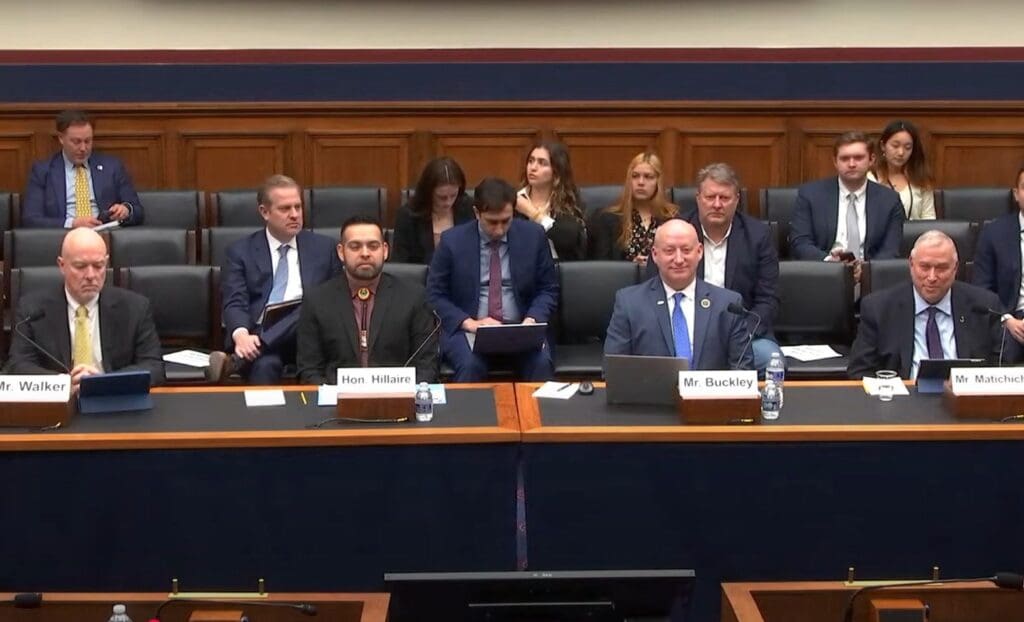
The U.S. House of Representatives’ Water Resources and Environment Subcommittee held a hearing Tuesday on “Water Infrastructure Financing: WIFIA and the Clean Water State Revolving Fund,” featuring four water sector experts who testified on current challenges and needs with the programs.
The four witnesses who testified were Jeff Walker, immediate past president, Council of Infrastructure Financing Authorities (CIFA), Honorable Tony Hillaire, chairman, Lummi Nation, Dan Buckley, past chairman, National Utility Contractors Association (NUCA) and Mike Matichich, economic and financial services consulting lead, Jacobs, on behalf of the United States Chamber of Commerce. The hearing was led by subcommittee chairman Rep. Mike Collins (R-Ga.) and ranking member Rep. Frederica Wilson (D-Fla.)
The hearing centered around the importance of EPA’s Clean Water State Revolving Fund and the Water Infrastructure Finance & Innovation Act (WIFIA) program as effective federal sources for funding local infrastructure projects. As pointed out in the hearing, the American Society of Civil Engineers and the U.S. Environmental Protection Agency (EPA) both estimate that the nation needs to invest more than $1 trillion over the next 20 years just to maintain and upgrade drinking water and wastewater systems. But annual SRF funding has hovered only in the billions, falling short of the pace of needed investment. Additionally, supplemental funding from the Bipartisan Infrastructure Law (also called the Infrastructure Investment and Jobs Act) was only authorized until FY 2026, making annual SRF appropriations all the more critical.
Buckley, past chairman of NUCA, whose membership includes water/wastewater utility contractors, remarked on several potential solutions to increase investment. These included preserving funding for the SRFs, reforming its earmark process, removing pay-go requirements and encouraging more private investment.
“We need more federal investment. The scale of this crisis demands it,” said Buckley. “As Congress debates the future of federal spending, lawmakers should consider reallocating more dollars towards these essential programs. Every dollar invested in water systems yields exponential returns in public health, economic growth, and environmental protection. By fully closing the water infrastructure needs gap, we could add as much as $4.5 trillion to the national GDP over the next twenty years.”
Buckley explained that EPA’s 7th Drinking Water Infrastructure Needs Survey, released in 2023, estimated a water infrastructure construction need of $625 billion over 20 years. The EPA’s Clean Watersheds Needs Survey, released in 2024, estimates 20 year needs north of $630 billion – a 73% increase from the last survey in 2012. Combined annual needs are more than $1.2 trillion. This suggests there are annual water infrastructure needs of approximately $60 billion, while funding for SRFs contributes only about $7 billion in annual investment.
Additionally, in the 118th Congress, just over half of the combined SRF appropriations were diverted to drinking water and wastewater project earmarks – leaving 39 states with a net loss of federal water infrastructure funding.
Buckley also commented on the potential of private investment, specifically Private Activity Bond (PAB) reforms that would incentivize private capital to flow into water projects, supplementing public funds. Buckley mentioned lifting the state volume cap on private activity bonds that fund water and wastewater projects, similar to what has been done in the transportation sector.
Also of note in the hearing was the focus on the challenges faced by small water/sewer systems. Matichich remarked on some changes that could be made to both programs to improve funding access to smaller systems.
“Even though the WIFIA program has provided some flexibility for small communities, interest in WIFIA by small communities has been limited,” Matichich said. “Small systems face higher costs per customer than large systems because they don’t have the same scale economies. As a result, even with the flexible financing terms by the WIFIA program, customer affordability remains a challenge for small systems. We believe further refinement to the WIFIA and CWSRF programs can improve their access by small systems and strengthen the long-term capacity of communities.
“First, offering small systems a subsidized interest rate such as two-thirds of the U.S. Treasury rate would make WIFIA financing more accessible. This would also more closely mirror the consideration given to small systems in the SRF programs.
“Second, expanding pre-construction financing opportunities enables water systems to demonstrate readiness for construction faster, thereby improving their access to the SRFs, WIFIA or other financing opportunities.”
A link to the full subcommittee hearing can be found here.








Leave a Reply