

By Charlie Suse
In November of 2021, the $1.2 trillion Infrastructure Investment and Jobs Act (IIJA) was passed, ushering in a historic infusion of federal funding to bolster the nation’s infrastructure. The IIJA appropriated roughly $43.5 billion for water infrastructure through the existing State Revolving Funds (SRF) administered by the EPA. Half of this amount supplements traditional Drinking Water and Clean Water SRF programs, with the remainder designated for projects addressing lead service lines and emerging contaminants (i.e., PFAS). In addition to the SRF channels, another $7.3 billion was appropriated for Water Infrastructure for the Nation (WIIN), Water Recycling and Desalination, Water Storage and Conveyance, and WaterSMART Grants, all supporting critical water management projects in western states.
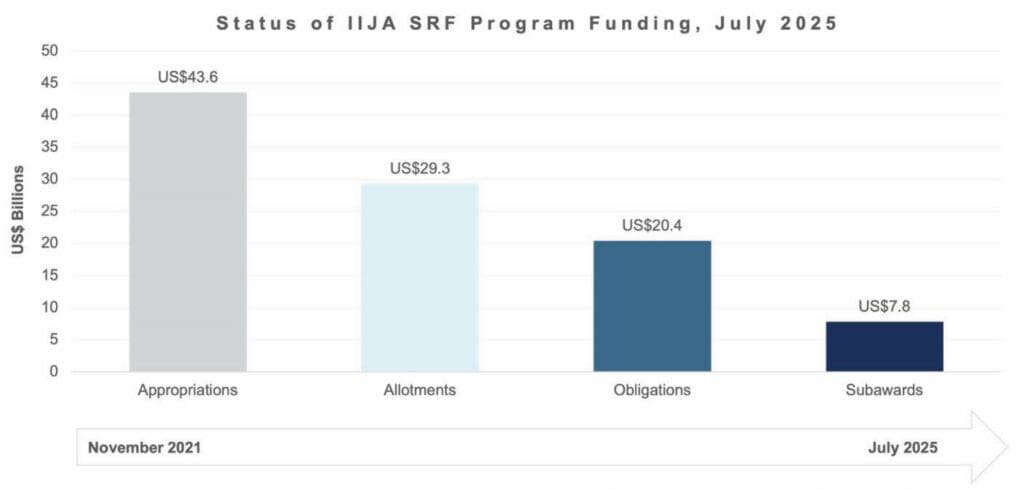
Each quarter for the last three years, Bluefield Research has tracked the progress of water infrastructure funding across these 10 discrete programs. As of July 2025, approximately $20.4 billion in IIJA SRF funding has been contractually obligated to state agencies by the EPA. This accounts for about 70% of the allotted funding to date for fiscal years 2022–2025 (excluding FFY 2025 allotments for lead service lines which have yet to be published as of writing).
Discrepancies Emerge in State Mobilization to Access Available Funding
On average, states have claimed 68.8% of their allotted funds from the EPA, yet stark discrepancies have emerged between states. Pennsylvania holds the distinction as the only state to have secured 100% of current allotments, while California and Texas have also been among the most proactive in securing funding. Meanwhile, Arkansas, Wyoming, Washington, and Oregon have each utilized less than 45% of their allotments.
These discrepancies reflect longstanding struggles in many states’ capacity to leverage traditional SRF funds. In a number of states, policymakers and utilities have suffered from a lack of clarity on program requirements and processes, coupled with complex frameworks for prioritizing projects.
While the rollout of funding has been slower than expected, the speed at which state agencies mobilize to secure obligations is a strong indication of where utility-level projects are likely to mature quickest. While states have until the end of September 2025 to submit an IUP for FFY 2024 allotments and claim allotted funding, lagging states risk further delays to projects and the potential reallotment of funding.

Project-level Awards Remain Highly Concentrated
Progress under the IIJA continues to lag at the project level, with only 18% of total SRF appropriations reaching recipients via subawards, which represents the last step in directing appropriated funding to specific projects at the utility level. Of the $8 billion in SRF subawards issued to date through IIJA, approximately 58% has gone to just 10 states.
California, New York, Pennsylvania and Florida — four states with some of the highest total allotments — have hosted the largest share project-level awards issued to date, totaling nearly $2.4 billion. The Midwest has also been at the epicenter of IIJA project activity, partially thanks to larger allotments for lead service line removal projects. Ohio and New Jersey, however, have tallied the fewest projects to date, with just over $6.8 million in subawards going out the door.
Reporting lags may also skew perceptions here — official award data can lag and under-reports by an average of 19% each quarter, in terms of total dollars. This means that actual progress is slightly higher than reported but still far below the pace needed to meet initial IIJA objectives. Although project-level awards began to ramp up in 2024, the lengthy timeline for SRF subawards means that the full amount of claimed IIJA funds may not reach communities until 2028 or later.
IIJA Progress Stalls Amid Shake Ups to Funding Landscape, Staffing Cuts
Award volumes declined sharply in the first half of 2025 due to a combination of executive orders, staffing reductions, and uncertainty over emerging contaminant regulations. Total project-level awards during H1 2025 were 53% lower than the same period in 2024. These governance challenges now outweigh previous concerns about tariffs, further slowing the rollout of IIJA funding and adding to the list of deferred projects.
The White House’s latest budget proposal for FY 2026 includes a 23% reduction in total funding for the Environmental Protection Agency (EPA), including a 31.5% cut in appropriations for the Drinking Water SRF and Clean Water SRF. Such reductions in federal funding would place an even greater burden on states and cities to fill the funding gap, while the delay in fund distribution threatens to extend project timelines, potentially heightening the demand for alternative financing models and private-sector partnerships to fill capital gaps.
Looking Ahead
Following a turbulent first half to 2025, the end of the fiscal year in September is likely to bring greater clarity on the funding outlook for IIJA as reporting on obligated funds peaks. While the disbursement of IIJA funding is expected to trickle out through the end of the decade, states that have been more proactive in claiming available funds will continue to see projects break ground sooner. With major cuts to federal funding for water on the table, state and local governments may face greater pressure to step up.

Charlie Suse is a senior analyst at Bluefield Research focused on the U.S. municipal water, wastewater and stormwater sector. He also leads Bluefield’s working group covering regulated utilities and third-party O&M. He has a background in geospatial analysis and sustainability, and his areas of expertise include infrastructure funding, utility consolidation and water policy.





Charlie,
I have been wondering about the BIL spending for lead. Back in April, I downloaded from the US EPA website their BIL projects related to lead service line removal. I came up with 434 total projects. They added up to $0.869 B. Out of a total of $15B set aside for lead. That comes to 5.7%. And we are about to start Year 4 of this supposed 5 year program. When I looked up those numbers again 2 months later, in June, the $0.869 B actually went down a little.
When I look at Ohio, $125M of its $808M has been awarded. That comes to about 15.5%. And again, just two years to go. I would love to share my files with you, if you are interested. If I am not thinking about this properly, I would love to be corrected. I have asked several people and have not gotten an answer to the question, if there is a ton of unspent money left at the end of 5 years, what happens ? Does it go unspent ? Would Congress have to grant an extension of time to keep spending it ?