
By André Noel
As a long-time leader in asset management programs, particularly for small- to mid-sized utilities, we are often asked about common challenges facing small and mid-sized systems when it comes to upgrading metering infrastructure.
What needs upgrading? Is it the meters themselves, or more about the network infrastructure and digital communications? These are all pieces of the puzzle that need to be addressed. To find the best answer, I believe that we need to dive deeper into the overall scenario that utilities encounter when assessing their situation and needs.
Understanding the Challenges – and Benefits – of AMI
AMI consists of many parts, including smart meters, the physical network infrastructure and all the layers of software that need to be installed and then managed. Today, the average age of meters in the system of a utility considering an upgrade is over 30 years. We’ve seen utilities with meters that are 30, 40 and 50 years of age that are still in the systems today. Of course, the performance of aging meters has a direct impact on a utility’s non-revenue water; it obviously reduces the revenue they can yield, and in fact, these poor performing meters have a huge impact across the entire utility.
But meters are just the first part of the equation. The implementation of a new network infrastructure and installation of new and sophisticated software require the services of a partner that has the requisite expertise and bandwidth to do it properly. While utilities may understand this, we have found that many underestimate what will be needed to keep the system up to date and running smoothly when situations requiring the need for troubleshooting arise. Their internal resources are not enough. This is when ongoing services such as those that USG Water Solutions provides yield immense value, and in fact, can save money over the long term by providing ongoing resources, requisite specialized expertise, and a predictable budget.
One other factor – and a significant challenge – is the staffing challenge that water utilities face. As the population ages, many employees are retiring and moving on, while at the same time, there is not an influx of new individuals coming into the water industry. In fact, this may well be the number one issue that is facing the water industry. As an example, consider who you see attending the water-related trade shows. At many shows, the youngest person that you’ll see on average is maybe in their thirties or forties.
With few young people coming into the industry, utilities must do more with less. And that, of course, affects every part of the organization. You have to look at ways to make it more efficient. And obviously the way to do that is to automate – one of the great benefits of AMI.
The Safety Factor
There is one other important benefit that an AMI system provides – one that may be too often overlooked but cannot be overstated. That benefit is the safety factor that utilities realize with AMI, which enables remote, constant monitoring, identification of water loss, all the things that tie into the system. This means that personnel are not subject to poor weather conditions, driving incidents, access to secure areas or a dangerous meter reading area for meter reading and shutoffs. The safety aspect is a key part of the value proposition not only from a financial and operational level, but from the human perspective as well.
Increasing Revenue by Implementing AMI
The benefits that one realizes by moving forward with an AMI system start with changing the water meter. The water meter is known very well in the industry as a utility’s cash register, and the new smart meters are the most efficacious. Aging meters may no longer be performing accurately, and as a result, the utility is not capturing an accurate amount of revenue every month. But replacing these meters with new smart meters will almost certainly help increase revenue. Concurrently, the utility should realize a reduction in its non-revenue water.
With AMI, utilities can also reap the benefits of a reduction in workload because manual reads, or re-reads, are no longer necessary. AMI also eliminates the need to shut off water manually if a customer fails to pay their bill. The same is true if someone, during the middle of the month, says that they are moving out, and someone else is moving into their home – before AMI, that would have required a reread and deployment of staff once someone moved out and again when someone else moved in. With a two-way AMI system with on-demand reads that can communicate directly with the meter – all of it comes to you.
So, one can imagine the field equipment, the fuel personnel, the trucks, etc. that would have been needed, and the savings that can be realized because there is no need to deploy any of these resources.
Think of this another way: once you have implemented AMI, instead of your staff being diverted from their primary responsibilities every single month, reading meters, rereads, move ins, move outs, shutoffs, you can nowredirect these resources and focus them on higher priority projects.
This can produce huge operational savings. In fact, with some of our clients, their savings are well into the six figures.
Addressing Staffing Shortages
Going back to an earlier point, while AMI can help mitigate some staffing shortages, over the long term we need to make the water industry attractive. We must show people who are coming into the industry or even considering a future in the industry, that it can lead to a lot of opportunities and career enhancement. Perhaps being a meter reader isn’t your ultimate goal, but it can take you far – for example, getting your water distribution license. Those who are in the industry and have these licenses are some of the most valuable people because these roles and responsibilities are critical to our overall water infrastructure, our water systems. And remember that there are a lot of utility directors who used to be water meter readers.
The Asset Management “as-a-service” Approach to AMI
Asset management as a service (AMaaS) is a powerful tool that enables utilities to reap the benefits of moving from reactive to proactive asset management at an agreed-upon, consistent cost, for a specified time. By engaging a partner that provides the latest technical knowledge and skills coupled with specialized human resources, AMaaS can optimize asset performance, reduce operational costs, relieve staffing issues, enhance service reliability, and improve customer satisfaction.
To decide if asset management is the right approach for your utility, you need to do your research. Undertake the due diligence, talk to other utilities that have AMI systems and use AMaaS, find out what are some of the pros and cons associated with it, and talk to them about their resources and how they’re taking care of the system and customers. Ask if they feel that they’re up to the task, or if they were aware that there are asset management programs like ours that will come in and take care of the system.
While this does take some time and work, an AMI system is a huge investment. So, you want to make sure they do that kind of due diligence. And by doing so, that will hopefully impress upon them the value of what we bring, and that it truly is needed. And remember that a lot of utilities still do not know that help implementing an AMI system is available and provides a tremendous return on investment.

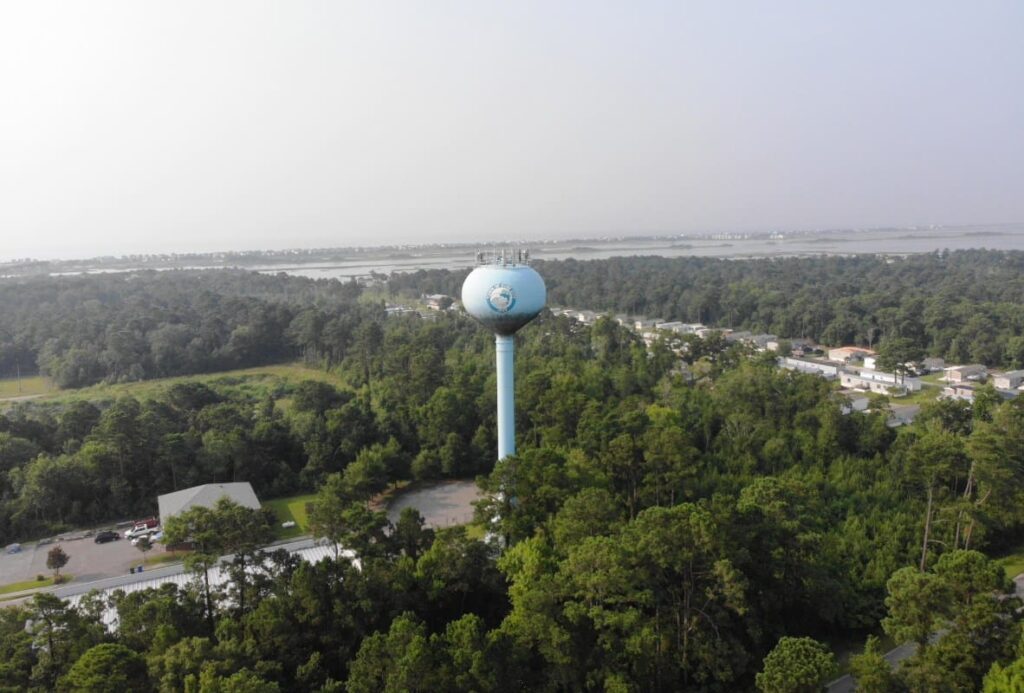
AMI Snapshot: The Town of Surf City, North Carolina
The Surf City Water Department has joined an increasing number of small- to mid-sized utilities that are taking advantage of the myriad benefits that AMI provides.
Working with USG Water Solutions, the Town implemented a turnkey AMI program that covers the entire AMI system from meters to transmitters, collectors, software, and billing interface. The system and smart meter services are integrated into the Town’s existing water distribution infrastructure for data collection and billing. System planning, procurement and deployment, daily operation, and asset maintenance, monitoring and management are all parts of the program. Its customized program, which spans 15 years, includes the inclusion of IT and administrative functions that eliminate the need for additional investment in human capital.
The AMI system monitors every meter, transmitter and collector daily, with regular reports that look for reading issues and ensure that no hourly transmission is missing. The network is also checked daily to ensure that the read rate percentage stays above 99%. The system also helps identify any abnormal consumption events, which can then be pointed out and resolved.
Benefits from the AMI system and AMaaS model include:
- Accurate and prompt billing notification;
- Proactive calls to alert customers to anomalies in their usage before issues become larger problems;
- Resource management that frees staff to perform tasks in line with their other responsibilities, and;
- Reduction in non-revenue water loss from 30% before the move to AMI to just 6%.
Final thoughts: No Plug and Play
One of the things we want to accomplish with this article is to help utilities understand and appreciate what we’re trying to do and what they should know if they are going to invest in an AMI system.
We believe in presenting the best solution for each client and promise to take care of the AMI system over its lifetime under a service level agreement. And that means bringing our resources out into the field and physically taking care of that water meter so that you can bill with all of your reads every single month. We also take care of the administration side, the monitoring, sending you daily email notifications – all those tasks.
Some manufacturers are just saying, “You can go it alone, just install it. We’ll turn over both sets of keys to you, and you’re good.”
But we disagree. This is where we’re saying “No, this is not a plug and play system.” Those who have had AMI for a while now probably realize that this is not a plug and play system. If someone gets a plug and play system and something goes wrong, who do they get to fix it? How much will that cost? Utilities consistently need help in these situations, and that’s where an asset management as-a-service approach comes in.

André Noel is director of revenue management and metering services at USG Water Solutions. With over 60 years of experience in maintaining water infrastructure assets, the company is the leading provider of asset management and rehabilitation services for the municipal water industry in the United States.








Leave a Reply