Salt Lake City Future-Proofs Large Diameter Water Mains

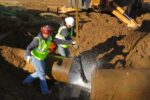
Murphy Pipeline crews perform 42-in. in-ditch butt fusion which includes a flanged 24-inch manway access on top, testing cap and 48 x 42-in, reducer ready for final connection.

By Jason Jones & Todd Grafenauer

Salt Lake City Department of Public Utilities (SLCDPU) owns and maintains a three-mile section of 48-in. water main. Referred to as the Upper Conduit pipeline, the main traverses from the Terminal Reservoir to the Baskin Reservoir and transmits potable water to the east side of Salt Lake City, Utah.

The majority of the pipeline functions in a gravity-flow condition, however, the portion that travels through the Parley’s Creek area acts as a low-elevation siphon and operates under pressurized flow. This pipeline was constructed circa 1955 and is made up of multiple types of concrete cylinder pressure pipe. Over the last several years, there have been concerns raised about potential leaks including other potential issues with the pipe and SLCDPU was concerned about this line reaching its functional life. In addition, access to this line is difficult and, in many cases, requires challenging and costly repairs due to the steep side slopes, proximity to homes, and difficult access in some locations.

Planning and Design

Pursuant to performing an inspection of the Upper Conduit, SLCDPU engaged J-U-B Engineers Inc. with the support of Lithos Engineers, to help solve the Upper Conduit concerns. The first part of the process was to perform an alterna­tives analysis and evaluation to help SLCDPU determine the best solutions for rehabilitating, or replacing the line. This team performed a review of the project parameters, reviewed applicable trenchless technologies and conven­tional construction techniques, estab­lished a decision matrix for the methods which included project descriptors, criteria, importance factors, and finally, provided recommendations including cost estimates. The methods included in the analysis were; loose-fit sliplin­ing, compression fit (tight-fit sliplining), pressure CIPP, carbon fiber reinforced polymer (CFRP), and replacement (both re-alignment, and in-kind replacement). The process required dividing the Up­per Conduit into different segments, or reaches, which provided lengths of the conduit which could be evaluated and considered together with the same criteria. The process resulted in the development of ten distinct reaches for evaluation and analysis. The study ulti­mately resulted in breaking the project into ten phases for construction based on estimated construction costs.

Trenchless Solution

Butt fusion of the 42-in. HDPE pipe along I-80 corridor.

The evaluation provided a clear pic­ture of which technologies were not only applicable for each reach of the pipeline, but also which methodology would be best, and if multiple methodologies were suitable. The design team quickly identi­fied specific factors that had more influ­ence on determining the recommended methodologies than others, and as a result a direction for recommendations developed quickly. Loose-fit sliplining, using HDPE pipe, was the recommended methodology for three of the segments due to low concern or need for capac­ity (final internal diameter could be reduced), slope of the existing line, acces­sibility for construction, long segments with few bends, or with bends that could be navigated with sliplining using HDPE.

Once the recommendations were accepted by SLCDPU, the design team developed a full design and construction set of plans and documents to perform slip lining with HDPE pipe.

Construction

The work completed by Murphy Pipelines to date has included multiple phases to replace 5,565-ft of existing 48-in. steel cylinder concrete pipe (SCCP) water pipeline including connections and new manway accesses. The sliplin­ing method installs a new pipe inside the existing failing pipeline. The new pipe is typically installed either by pushing or pulling the new pipe into the host pipe with installation distances of a few hun­dred feet up to one mile at a time.

Steep slopes as Murphy Pipeline crews position the 42-in. HDPE pipe for sliplining.

The technology is advantageous for replacement as the method is cost effec­tive requiring only a few access pits. This reduces restoration efforts including environmental impact. The method also follows the existing utility path which can be critical as many cities do not have an available easement to relocate the new pipeline, especially for large diameter transmission mains located in congested utility corridors. Specific to the Upper Conduit project, due to the project location within the Parley’s Creek Canyon with steep slopes and challenging access, slip lining allowed for entry and exit pits to be located at accessible locations. Parly’s Creek is also a protected watershed so limiting the environmental impact of construction activity was essential. In total, excavation was reduced by 90 percent of what an open-cut option would have required.

In addition to the technology, HDPE pipe played a large role in the success of the work. Murphy Pipeline crews uti­lized the continuous sliplining method in which 50-ft sections of 42-in. HDPE pipe were butt fused to the installation lengths of each pull. The butt fusion process affords the new piping system to be installed as one monolithic system eliminating the potential for future leaks. Selecting a pipe material to install with slip lining often requires a pipe material that coincides with construc­tability. While generally HDPE pipe has become a preferred choice for trench­less projects, the specifics of this work required the new piping system to be light weight for ease of transportation and movement on the job site.

To have a high degree of flexibility as the HDPE traversed over steep slopes and the ability to navigate bends within the existing 48-in. host pipe. The material also needed to have a high impact strength with ductility and toughness. The selection of the sliplin­ing technology in conjunction with HDPE pipe allowed the project to be constructed within the constraints of the project geography and location.

With cities needing to replace a vast amount of aging water and sewer in­frastructure, many are finding value in one of the oldest and simplest trenchless technologies of sliplining.


This article first appeared in the June/July edition of Trenchless Technology, a sister publication to WF&M.
Jason Jones, P.E., is program manager with J-U-B Engineers.
Todd Grafenauer is educational director with Murphy Pipelines.

Leave a Reply

Your email address will not be published. Required fields are marked *