

Innovation Meets Groundbreaking Construction at Hampton Roads Sanitation District
If you follow innovative water infrastructure projects in the United States – especially those in the water reuse category – you’re probably familiar with Hampton Roads Sanitation District’s (HRSD) Sustainable Water Initiative for Tomorrow (SWIFT) program.
The SWIFT program seeks to enhance the sustainability of the region’s long-term groundwater supply by recharging the Potomac Aquifer. But the goals are multifaceted – first and foremost to reduce nutrient pollution in the Chesapeake Bay – along with improving Virginia’s groundwater supply, reducing saltwater intrusion and reversing land subsidence. The program is significant and unique in that HRSD, a wastewater management district, is treating wastewater to potable standards to recharge the aquifer and replenish the groundwater supply.
It’s science meets engineering and construction.
The SWIFT program is at the center of HRSD’s work and has been in development for several years. Some construction projects have been completed with others breaking ground.
Water Finance & Management recently got a chance to explore some updates on the SWIFT program, examine some projects in the works and other endeavors for HRSD.
Hampton Roads Sanitation District
Hampton Roads is located where the James, Nansemond and Elizabeth rivers pour into the mouth of the Chesapeake Bay and meet the Atlantic Ocean to the region’s east. HRSD provides wastewater collection and treatment services to a population of more than 1.7 million that includes 20 cities and counties in southeast Virgina and along the Eastern Shore.
The district is a political subdivision of the Commonwealth of Virginia and is governed by a governor-appointed commission. Its infrastructure includes a collection system of more than 500 miles of pipes, more than 100 pump stations and 14 treatment plants. Its total combined treatment capacity is around 225 million gallons per day (mgd).
SWIFT Background, Drivers
As the largest estuary in the nation, the Chesapeake Bay is impacted by phosphorus and nitrogen pollution, and over the years, state regulations have tightened for nutrient discharges into bay and its tributaries.
The inception of the SWIFT program came from several drivers. First, one of the major initiatives for the district has been reducing sanitary sewer overflows (SSOs) to the Chesapeake Bay, for which HRSD is under a federal consent decree from the U.S. EPA and Department of Justice. HRSD has a $2 billion program to reduce the SSOs that extends out to 2040.
Concurrently, upgrades to treatment and process equipment to meet discharge standards were driving up costs for the district.
For these reasons, under former HRSD leadership, the district was considering the financial feasibility of leapfrogging past incremental upgrades to wastewater treatment and instead treating its wastewater all the way to potable standards.
Part of the reason HRSD considered this was because at the same time, the state was beginning to have problems with its groundwater supply and was cutting groundwater permits in eastern Virginia. In fact, 14 of the largest users of groundwater in eastern Virginia had their permits cut at one point around 2016.
Twenty percent of all Virginians use groundwater as their primary source of drinking water. In eastern Virginia, the Potomac Aquifer is the region’s primary source of groundwater and is impacted by saltwater intrusion based on its location on the coastal plain.
With all things considered, HRSD explored the idea of replenishing the aquifer by way of recharging it with treated, potable water. Following a feasibility study, which HRSD completed with Jacobs, the district decided to move forward with the SWIFT program after approval from EPA and Virginia regulatory agencies.
SWIFT in Progress
HRSD completed a pilot/demonstration facility in 2018 that also serves as a SWIFT research center. While HRSD originally planned to build five additional facilities, the district has shifted direction and instead decided to move forward on two full-scale SWIFT facilities that are currently under construction.
The first is being constructed at HRSD’s James River Treatment Plant located in Newport News, Va. The SWIFT portion will consist of a 16-mgd facility and recharge wells. It is expected to be completed by fall of 2026. Additionally, at HRSD’s Nansemond Treatment Plant in Suffolk, Va., work is underway on the Nansemond SWIFT Facility and recharge wells that will have a 34-mgd capacity, bringing the total aquifer recharge capacity to 50 mgd between the two facilities. More on these below.
Regional Benefits
HRSD General Manager and CEO Jay Bernas says he’s excited about the multifaceted benefits and opportunities the SWIFT program presents to the region.
“[Currently] there are no new industrial wells allowed in eastern Virginia because the aquifer levels have declined by more than 200 ft in the last 100 years. It doesn’t get naturally recharged and the water just continues to get pulled out,” he says.
Bernas says the notion of recharging the Potomac Aquifer opens up economic growth potential for the region.
“A lot of the data centers in the world are housed in Virginia, and Google just committed $9 billion to the state,” he says, explaining that the water resources from replenishing the Potomac Aquifer would help to support infrastructure such as data centers that require intense water use.
“It’s an underground storage tank,” he says. “There’s a huge economic development opportunity there.”
But how long will recharging the Potomac Aquifer actually take?
As Bernas explains, a Virginia Department of Environmental Quality report in November 2024 noted that halting groundwater use creates a pressure wave, also called a “hydraulic surge” that can travel through the aquifer. Likewise, HRSD believes that recharging the aquifer will similarly happen on an accelerated timetable due to the high-pressure water injection.
“It’s not going to be a decades-long geologic process,” Bernas says. “It’s going to happen pretty quickly because of the transmissivity of the aquifer.”
Land Subsidence
Taking water out of the ground at the current rate has led to sinking of land in some parts of eastern Virginia. According to the U.S. Geological Survey (USGS), eastern Viginia has the most vertical land motion of any region on the east coast of the United States. Addressing it is another goal baked into the SWIFT program.
Land subsidence makes the region more vulnerable to rising sea levels and associated impacts. By replenishing the aquifer, the system may be able to slow or even reverse the sinking of land due to withdrawal.
Bernas notes that a recent USGS data analysis found that there’s a strong correlation between water levels and the amount of compaction and land subsidence that’s occurred.
“There’s an elastic component to the aquifer where if water levels go up, there’s chance the land will actually rise,” he says. “We can’t control sea level rise, but maybe we can control how much we’re sinking.”
Bernas adds HRSD is excited for some of the short-term results on the aquifer recharge components of the program as the James River and Nansemond SWIFT facilities begin to come online.
James River SWIFT Facility
The James River SWIFT Facility in Newport News will be the first full-scale SWIFT facility. It is expected to be online in fall of 2026 and will be able to replenish the Potomac Aquifer via seven recharge wells with up to 16 mgd of SWIFT Water®.
The project includes Advanced Nutrient Reduction Improvements (ANRI) for the James River Treatment Plant and will also include land improvements and updates to nearby park amenities.
AECOM is serving as the program manager with a contracting team consisting of Ulliman Schutte – Alberici Joint Venture (SWIFT and ANRI), A.C. Schultes (Well Drilling) and Trails (Howard Brothers).
James River Crossing
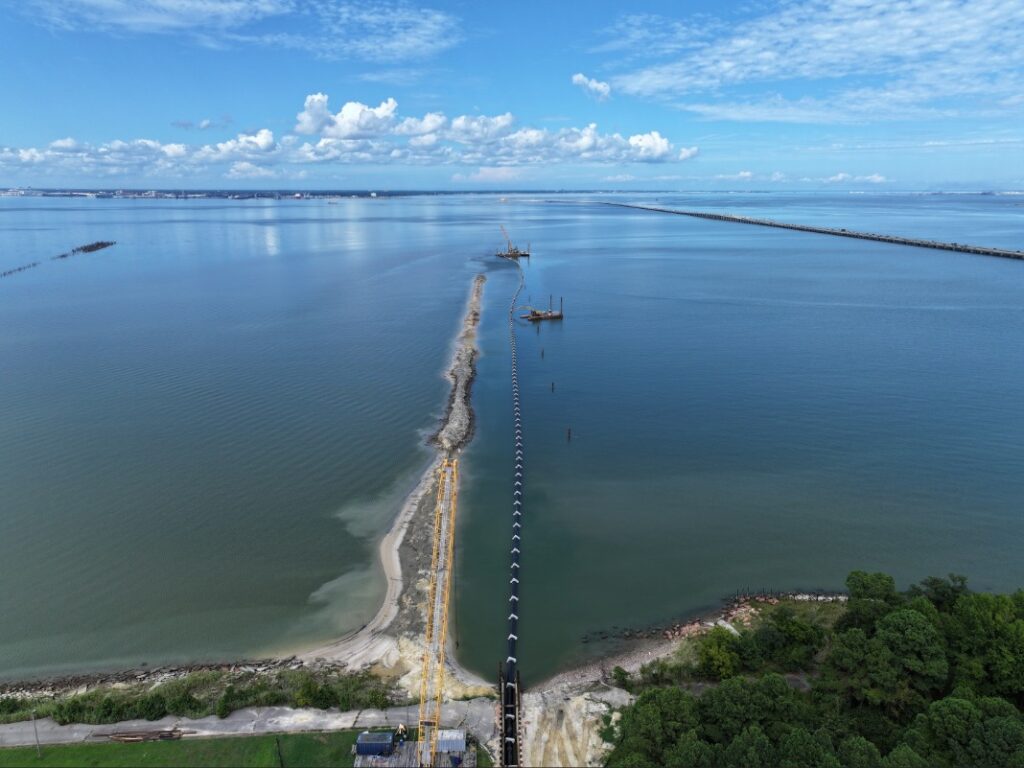
When discussing the SWIFT program, it’s difficult to not mention HRSD’s recent James River Crossing (JRX), which saw the installation of a new sewage force main underneath the James River to convey wastewater to the Nansemond Wastewater Treatment Facility in Suffolk. The subaqueous crossing was only part of the total pipe being installed that will connect to Nansemond.
The project first involved the closure of HRSD’s existing Boat Harbor Treatment Plant in Newport News and the construction of a new pumping station at the site. The pump station will be used to convey the raw sewage under the James River – known as the Newport News Shipping Channel – to the Nansemond facility.
Using a design-build delivery method, the JRX team completed the crossing under the shipping channel in May 2024, led by engineer Dewberry and contractor Garney, a national water and wastewater contractor.
Originally planned as a water-to-water horizontal directional drill (HDD), the Garney-Dewberry team extended the HDD alignment to the shoreline. This move added 2,300 ft to the drill length but eliminated the need for marine trenching. The now water-to-land HDD was launched from a temporary pile-supported platform in the James River as the bore extended to the north shoreline. The change resulted in more than $10 million returned to the owner through credits tied to the original LS design, while also solving the land-to-water transition challenge on the north shore near an active ship fleeting bulkhead.
The bore, which reached depths of about 100 ft below the river floor (~170 ft below the river surface), marked a record-setting 5,700-ft HDD and pullback under the challenging marine conditions. The project installed 42-in. HDPE pipe, of which Garney says the project is the world’s longest-known pullback of 42-in. HDPE.
The JRX design-build team included Huxted Trenchless, which performed the HDD portion, Seaward Marine, Brierley & Associates and Michael Baker, Inc. Overall construction on the subaqueous section of the force main was wrapped up by the end of 2025.
Garney is also leading the land portion of the install, which includes 6,650 lf of 48-in. HDPE sanitary force main. It is also responsible for the installation of 2,850 lf of 30-in. water main that will carry treated SWIFT water, 3,650 lf of 16-in. PVC backflush main and 1,200 lf of 12-in. water main. The work also requires a 400 lf of microtunnel beneath I-664 lined with Permalock casing – this is the segment that will connect to the Nansemond plant.
Nansemond SWIFT Facility
Similar to the James River facility upgrades, the project at Nansemond will first involve Advanced Nutrient Reduction Improvements (ANRI) that are being designed by Tetra Tech with Garney as the contractor. The upgrades will increase the plant’s capacity to 50 mgd and will accommodate the wastewater flow from the Boat Harbor location via the JRX.
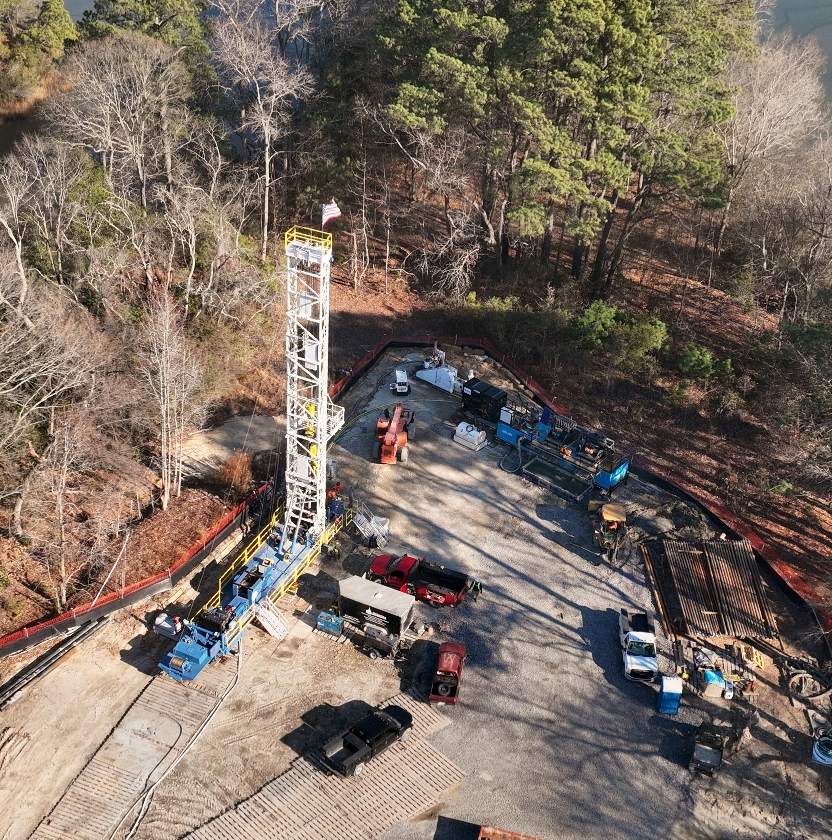
Garney will also construct the SWIFT upgrades, which include the installation of 19 managed aquifer recharge wells that will have the capacity to inject 34 mgd into the aquifer. The engineering work on the SWIFT portion is being led by Tetra Tech and Carollo.
The advanced treatment process will incorporate a combination of ozone biofiltration with granular activated carbon adsorption to remove contaminants and chemicals from the water, as well as ultraviolet (UV) disinfection.
The Nansemond SWIFT Facility is expected to begin operations in 2029. By 2032, the SWIFT program aims to reach its 50-mgd aquifer recharge capacity between the Nansemond and James River facilities.
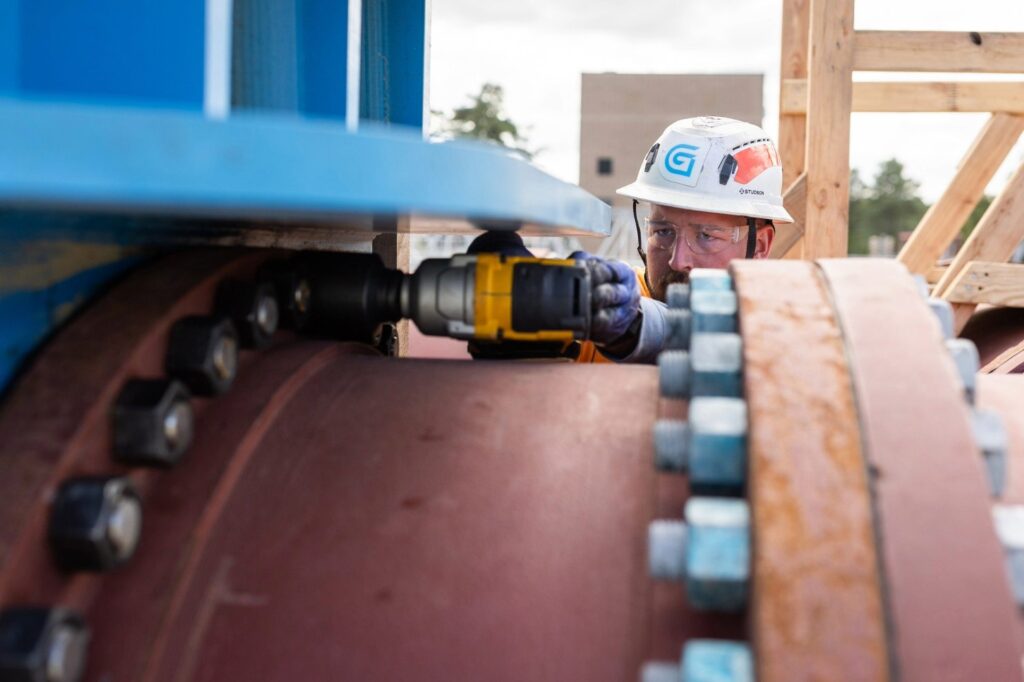
From a construction standpoint, Garney has been heavily involved in the SWIFT program thus far. For the record-breaking HDD under the James River alone, the North Kansas City-based contractor says more than 50,000 labor hours went into the project with no safety incidents.
“Going under the river was the biggest challenge,” Dan Buckley, Garney Preconstruction Executive, says of Garney’s work on SWIFT.
“The impact that the construction has had on Garney is significant. We’ve also relocated 125 personnel to Virginia from other areas of the country. They live there now and they’re staying. It’s made a huge impact economically.”
R&D
The larger connection to economic development in the region that SWIFT is tied to is no accident. HRSD has worked to build what Bernas calls a water innovation ecosystem in the region.
“We’re trying to build the Silicon Valley of water tech in Hampton Roads,” Bernas says.
“At HRSD, we’re a political subdivision – we don’t make a profit, but we are a community member. We think about how we can leverage our R&D to make a larger community impact and we can do it through economic development.”
The district has encouraged a culture of enabling applied research and development and has actively worked to bring water innovations to market. HRSD has one of the largest R&D groups of any wastewater utility in the United States. It employs 23 staff members – including six with Ph.D.’s – along with 11 active patents and six patents pending.
“We want to be tech enablers,” Bernas says. “One of the things we see in the innovation space is that there aren’t a lot of utilities like us that are willing to take risks on certain startups.
“They can’t get references to test their technology because nobody wants to be the first to test something at scale at one of their plants – but we will,” he says, referencing promising innovations in AI, energy particle accelerators for PFAS treatment, and more.
“It’s about being a tech enabler, but more importantly, trying to drive economic development to the region.”

Andrew Farr is the managing editor of Water Finance & Management. He has covered the U.S. water utility sector for 14 years along with other construction markets for publisher Benjamin Media, based in Richfield, Ohio.






Leave a Reply