
Twin Cities Area System Eliminates PFAS from Well Water Using Granular Activated Carbon
By Robert Bergsgaard
Located in the Twin Cities metro area, the City of Cottage Grove, Minnesota, needed to increase the capacity of its drinking water system to meet the demands of increasing population while also satisfying the U.S. Environmental Protection Agency’s (EPA) updated requirements for reduced PFAS in the water supply.
The PFAS requirements now have a cap of four parts per trillion on the maximum containment level (MCL) for perfluorooctanoic acid (PFOA) and perfluorooctane sulfonic acid (PFOS). According to city demographics, the total population of Cottage Grove increased by 12.3% from 2010 to 2020, and it continues to grow 2.43% annually, with projections of reaching 48,200 by 2029.
This dual challenge of demands from an increasing population coupled with higher environmental standards required a comprehensive solution — modernizing infrastructure, incorporating advanced treatment technologies, and ensuring compliance with evolving standards.
Project Initiation and Key Objectives
AqueoUS Vets® (AV), a company specializing in the removal of PFAS and contaminants of emerging concern (CECs), began the project by working with the city to develop a comprehensive assessment of its water quality, current infrastructure and specific treatment challenges. This included a detailed evaluation of the water source, PFAS levels and presence of other contaminants in the water, flow rates, and treatment goals — based on both capacity and regulatory compliance requirements. This assessment was followed by a feasibility study to determine which filtration technology might best fit the city’s needs.
When AV identified granulated activated carbon (GAC) or Ion Exchange (IX) as a potential solution, they conducted an analysis to consider its capabilities for effectively removing contaminants from well water in Cottage Grove. The key objectives for the project included:
- Meet regulatory requirements to comply with EPA’s maximum contaminant level mandate for PFAS contamination.
- Improve water quality and safety to safeguard the health of the city’s residents and boost consumer confidence in local resources.
- Enhance the system’s capacity and reliability to meet growing demand from population growth and additional regulatory requirements.
- Optimize operation expenditure (OpEx) to strategically manage costs, ensuring the effective use of resources throughout the life of the project.
- Achieve a lower total cost of ownership (TCO) for pumping water and building requirements to deliver the best value over time and minimize the long-term costs associated with acquiring, operating, and maintaining the filtration system and facilities.
Challenges
A large-scale upgrade for municipal water utilities requires a significant upfront capital investment in addition to ongoing expenditures. In addition, every municipal water treatment facility operates in a unique context. Local geology, water source quality, space constraints and local ecosystems present distinct characteristics that must be considered.
For the Cottage Grove project, the AV team determined the overall pressure drop should not surpass 3 pounds per square inch (psi) when the media is not present, so that the filtration system maintains optimal flow rates and efficiency under varying operating conditions. Constraint on the pressure drop is critical to prevent excessive energy consumption and avoid overloading the system.
Additionally, to comply with physical space limitations and regulatory clearance requirements, the height of the pressure vessels should not exceed 23 ft, 4.5 in. Meeting this condition involved factoring in vibration control, weight distribution, and system balance — all factors that affect the overall performance and longevity of the system. It also required integrating the filtration vessels within the existing infrastructure without losing accessibility for future maintenance or threatening the facility’s structural integrity.
Solution and Approach
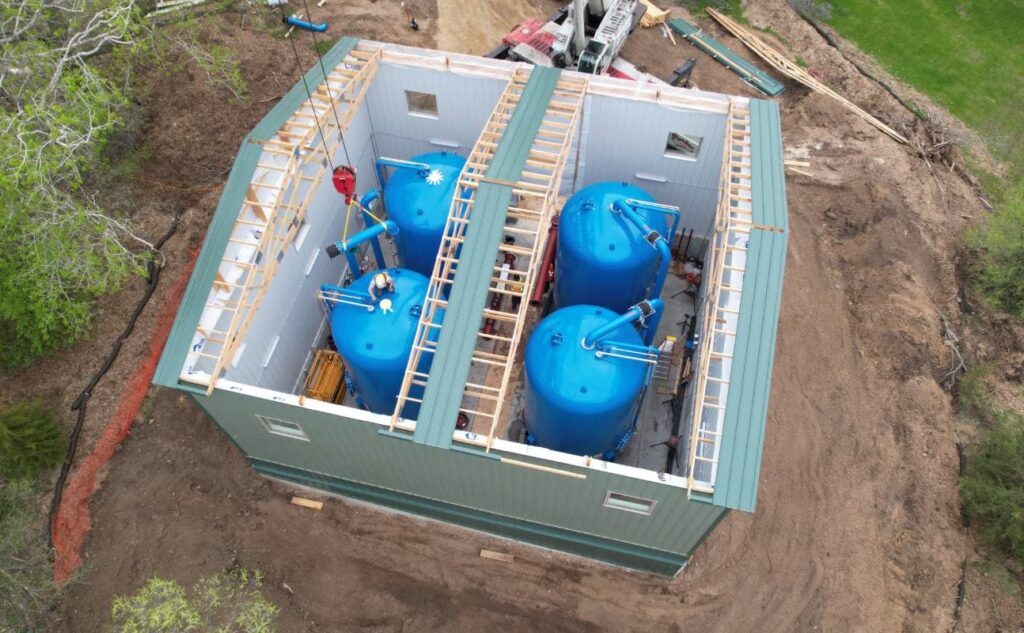
To address the concern of the initial investment and ongoing expenditures, AV implemented its patented LowPro® System, strategically managing costs and delivering the best value over time. To meet the increased demand on the water supply, they equipped two additional wells with treatment systems designed to reduce PFAS.
The city contracted consulting firm Stantec to provide engineering services for the design, during procurement, and construction of the facilities and site infrastructure for the dual media LowPro systems; designed to utilize either granulated activated carbon (GAC) or Ion Exchange (IX) media.
Following a detailed evaluation to determine the scope of supply for the initial GAC systems, the AV team will provide three 12-ft diameter model 12-1340 GAC/IX (dual media capable) systems. At one location, two systems will operate in parallel, with each system having two vessels (lead/lag) operating in series. The second location will have one system with two vessels (lead/lag) operated in series. The systems will use NSF 61 and Minnesota Department of Health approved Norit 1240PLUS GAC bituminous coal acid-washed carbon to reduce the PFAS compounds below the Minnesota Health Index discharge requirements.
To accommodate the expansion of the carbon media during the backwash of the GAC, the sidewall of the vessels is designed to provide sufficient space for the required bed expansion for the specified media. Because bed expansion can range from 20% to 50% of the total bed height, the vessel sidewalls are designed with increased clearance to fully expand without causing stress on the structure or damage to the vessel walls.
Key Achievements
The overall delivery time from contract execution to installation was six months. This is a notable achievement in a project that aimed for optimal operation expenditure, efficient procurement processes, minimal disruption in service, and timely resolution of water quality and capacity issues.
In addition to the timeliness of delivery, the project also demonstrated effective collaboration. The AV team provided an installation supervisor to work with the selected contractor throughout the system commissioning process, ensuring the company’s design specifications were carried out and best practices followed. This collaborative effort protected the integrity of the system and prevented costly errors.
Among the other notable achievements of the project, regulatory compliance is at the top of the list. Cottage Grove can now be confident its new PFAS filtration system meets or exceeds evolving local, state and federal regulations, effectively removing PFAS and other emerging contaminants.
In addition, the project successfully streamlined procurement and supply chain management. AV navigated procurement of project materials and handled any supply chain challenges in order to secure essential materials on schedule.
Safeguarding public health was a major goal of this project. The city is now meeting the EPA’s standards for water quality while also protecting the health and well-being of the public, which was one of the primary drivers for the project. The installation of the PFAS filtration systems also position the city to accommodate future growth without compromising the quality of its well water or the reliability of its service.
The project also helps to modernize Cottage Grove’s infrastructure. Upgrading to advanced filtration methods allows the system to handle emerging contaminants in the future better because of its Dual Media design and capability while also enhancing its resilience, reliability, and ability to adapt to future water treatment challenges. Cottage Grove is now better equipped to meet both current and future demands.

Robert Bergsgaard is sales and business development engineer for the Midwest Division at AqueoUS Vets. With more than 34 years of experience in the water treatment market, Bergsgaard has a broad knowledge in project management, operations, service and various positions within the equipment sales and rental business. He previously worked as business development manager at Evoqua Water Technologies.








Leave a Reply