

By Krystal Strassman
As Florida continues to lead the nation in water reuse innovation, a landmark legislative shift is reshaping the future of wastewater treatment. Senate Bill 64, signed into law in 2021, requires domestic wastewater utilities to eliminate nonbeneficial surface water discharges by January 1, 2032, or earlier if no approved plan is submitted. This bold move aligns with the growing push toward zero discharge, a concept that reimagines wastewater not as waste, but as a resource.
Meeting this mandate requires more than technology; it calls for careful planning, regulatory alignment and solutions tailored to local conditions. Across Florida, utilities are advancing projects that balance compliance with long-term community benefits. Our team has been fortunate to work alongside several of them, helping evaluate treatment alternatives, navigate permitting and budget challenges, and implement strategies that move the state closer to zero discharge.
Water Reuse Facility – Irrigation with Community Impact
In Jacksonville, Florida, a new, greenfield, water reclamation facility (WRF) provides tertiary treatment with filtration and disinfection, producing high-quality reclaimed water for the irrigation of parks, golf courses and neighborhoods. This 4 million-gallon-per-day (MGD) facility, expandable to 12 MGD, provides a cost-effective reuse program that reduces potable water demand while earning community support through visible, everyday benefits.
Nassau County – Deep Well Injection for Aquifer Protection
In Nassau County, Florida, an expanded WRF added capacity with an additional 2 MGD expandable to 4 MGD. It features advanced secondary treatment followed by deep well injection, ensuring zero surface water discharge. While permitting and cost posed challenges, the project demonstrates how utilities can protect aquifers and achieve compliance through proven, long-term solutions.

AquaNereda® and the Path to Zero Discharge
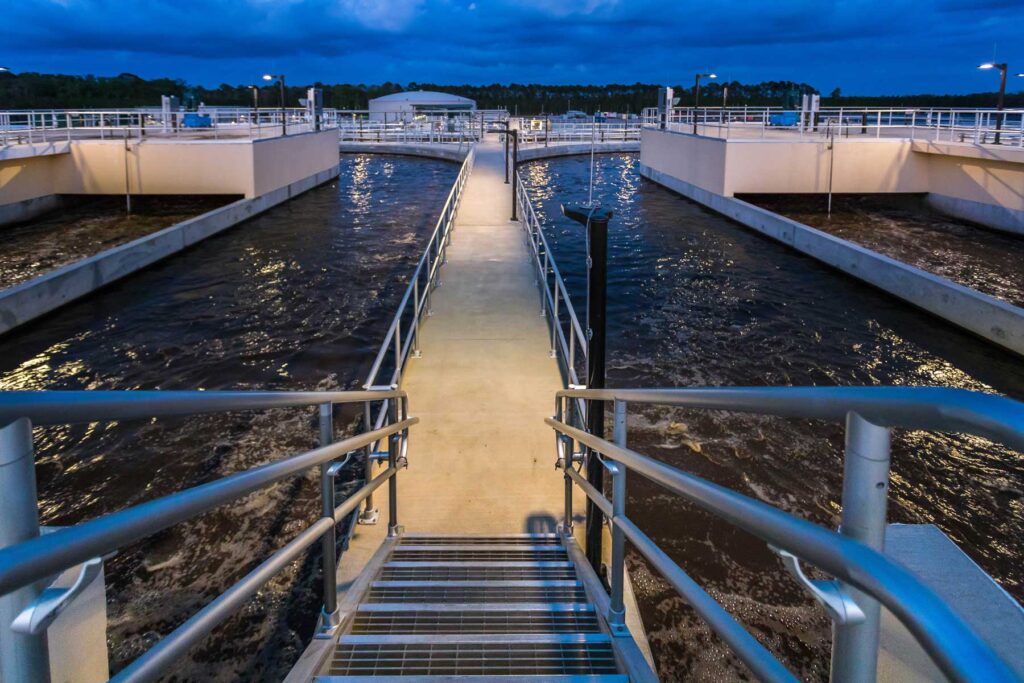
The City of Fort Pierce is pioneering AquaNereda® aerobic granular sludge technology, one of the largest systems of its kind in the U.S. This 8 MGD process achieves enhanced nutrient removal with a smaller footprint and lower energy use than conventional activated sludge. Designed to eliminate surface water discharge by maximizing reuse and aquifer recharge, the facility reflects how innovation and sustainability can align with regulatory requirements.
Water Purification Research Center – A Vision for Potable Reuse
As one of the state’s fastest-growing cities, Jacksonville is preparing for the future with an indirect potable reuse program that applies a multi-barrier approach, including reverse osmosis and advanced oxidation. The initiative looks beyond compliance to strengthening regional water security while emphasizing public engagement and education. It is building trust and understanding around the potential of advanced treatment technologies.
The Path Forward
Florida’s regulatory mandate is accelerating change, but it also highlights the value of early planning, strong community outreach, and the ability to balance upfront capital with long-term operational savings. Utilities across the state are proving that compliance can go hand in hand with innovation and resilience.
By 2032, the wastewater landscape will look dramatically different. With direct and indirect potable reuse, advanced biological treatment, and aquifer protection strategies already underway, Florida is setting a benchmark for how regulations can drive forward-looking water management—and how collaboration can turn challenges into opportunities for lasting community value.
Collaboration will be essential as Florida utilities move toward the 2032 deadline. Our team is committed to supporting municipalities and utilities in evaluating options, navigating permitting and budget challenges, and implementing sustainable solutions that achieve company compliance while protecting long-term water security. Let’s start the conversation about how your community can turn today’s regulatory challenges into tomorrow’s opportunities.










Leave a Reply