

If you haven’t heard, there’s still a lot going on with regulatory and legal action related to PFAS and other “forever chemicals.” To get an update, we sat down with Ken Sansone, senior partner at SL Environmental Law Group, to discuss recent activity. Sansone focuses exclusively on representing public entities in litigation over the contamination of public resources including water, land and other natural resources.
Water Finance & Management: Can you give us a general update on where legal action against “forever chemical” manufacturers 3M, Dupont and others stands? Are drinking water systems and other entities still filing claims as part of the ongoing multi-district litigation?

Ken Sansone, SL Environmental Law Group: Legal action against PFAS manufacturers 3M, DuPont, and others is still in progress, and entities continue to file new claims in the AFFF MDL. Utilities that qualified for funds under Phase I of the 3M and DuPont drinking water settlements – the largest of their kind in U.S. history – are now receiving their first payments. Meanwhile, utilities that did not detect PFAS in their water supplies until after the settlements were announced in June 2023 remain eligible for Phase II of the settlements. For water systems that opted out of the settlements, the only way to receive funds from 3M and DuPont will be through successful litigation.
Entities with known or potential PFAS impacts to soil, such as airports and fire training facilities, as well as operators of landfills and wastewater treatment plants dealing with additional PFAS disposal costs , may also file lawsuits in the AFFF MDL. These claims will continue to be litigated and are expected to be resolved by future settlements or, if necessary, trials.
WFM: In which cases should water systems look to bring their own legal action to polluters as opposed to joining the existing MDL? Could they potentially increase their settlement payout by doing so?
Sansone: It’s important to remember that, by filing a case as part of the MDL, a water system or other plaintiff does not surrender its right to decide how to handle that case, including whether to join in any settlement opportunities that arise, or to continue moving the case toward trial in hopes of a better outcome. But filing in the MDL provides certain advantages, including not having to participate in potentially burdensome discovery processes (seeking discovery from plaintiffs beyond a short “fact sheet” form is not permitted). Filing outside of the MDL not only imposes those sorts of burdens on plaintiffs but also risks a prolonged legal battle with the manufacturers of PFAS, who are likely to try to move the case to the MDL anyway. For these reasons, we generally discourage public agencies from trying to file cases outside of the MDL, outside of very unusual circumstances.
WFM: What are some upcoming deadlines for Phase II class water systems to submit testing claims and other forms to be eligible for compensation? Any other recent activity with regard to the lawsuits and settlements worth sharing at this time?
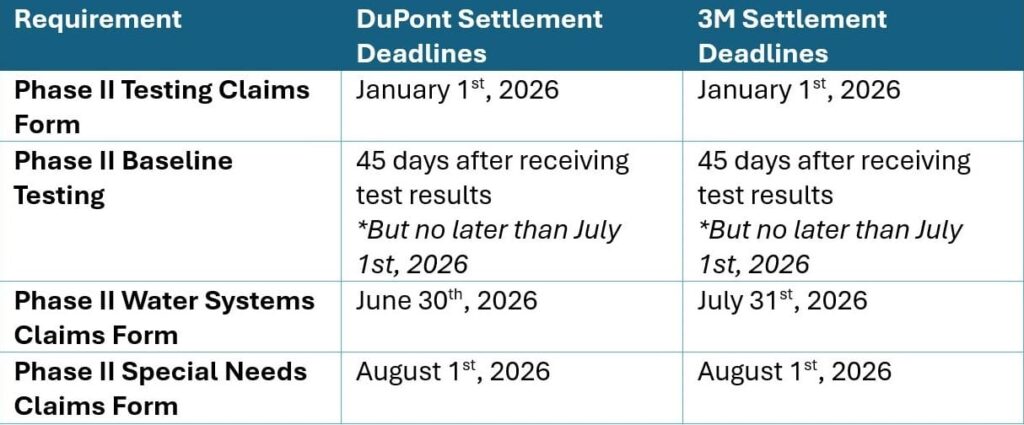
Sansone: All community public water systems are eligible for Phase II of the 3M and DuPont drinking water settlements unlessthey detected PFAS in their water supplies before the settlements were announced at the end of June 2023. These systems will need to prepare and file significant documentation within specified timeframes. For systems in that group who want to claim the costs of testing for PFAS in their sources, Phase II Testing Claims Forms are due Jan. 1, 2026, for both the DuPont and 3M settlements. Both settlements also require Phase II baseline testing to be submitted within 45 days of receiving test results, but no later than July 1st, 2026. Phase II Water Systems Claims Forms are due June 30, 2026, for the DuPont settlement and July 31, 2026, for the 3M settlement. Finally, Phase II Special Needs Claims Forms are due Aug. 1, 2026, for both settlements; these claims enable water systems to try to recover their actual costs of responding to PFAS detections in their supplies, including for the engineering, construction, operation, and maintenance of treatment plants.
WFM: In May, EPA proposed an update to the National Primary Drinking Water Regulations for PFAS that would keep maximum contaminant levels for PFOA and PFOS at four parts-per-trillion, albeit with extended compliance deadlines to 2031. How, if at all, does this proposal affect current PFAS settlements and payouts?
Sansone: These proposed updates will not have an impact on the current PFAS settlements and payouts, which are calculated based on formulas that use 4 ppt concentrations of PFOA or PFOS, rather than the actual MCLs, as the relevant factor
If systems are eligible for payments through the settlements and no longer require PFAS treatment to achieve compliance, they may choose to allocate the funds to other projects. For most water systems, the practical effect of rescinding the MCLs and hazard index for shorter chain PFAS will be limited, as it is very rare to have high levels of these other contaminants in sources that do not also have PFOA and/or PFOS detections exceeding the MCLs.
The extension of compliance deadlines for the PFOA and PFOS MCLs will come as welcome news for many water systems, as implementing PFAS treatment can be both expensive and time consuming. Utilities will now have more time to complete feasibility studies, seek funding and design and install treatment systems.
WFM: How likely are we to see more examples of legal recovery and recouping compensation?
Sansone: We are very likely to see more examples of legal cost recovery for PFAS contamination in the coming years. In reaching these landmark settlements with PFAS manufacturers, drinking water systems have demonstrated the effectiveness of litigation in helping agencies address contamination clean-up costs. This has laid the groundwork for potential future settlements for other entities and operations affected by PFAS, such as wastewater treatment, airports, landfills, and fire training facilities.
WFM: Federal support for PFAS cleanup and other water infrastructure projects continues to be unpredictable. How can the sector better urge water systems to be proactive in pursuing legal pathways to recouping compensation?
Sansone: For drinking water providers, the settlements have already provided sources of funding that can be accessed even without the need for filing a lawsuit or other legal action (although experienced counsel are essential to maximizing the value of claims under the settlements). Water systems should understand that, by failing to pursue claims against these settlements, they are effectively leaving money on the table that’s already been left out for them.









Leave a Reply