

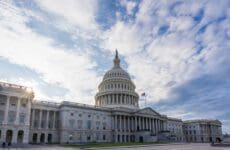
Last week, more than 750 water utility professionals from across the United States convened in the nation’s capital for the annual Water Week, featuring Congressional office visits and policy updates from sector leaders and regulators.
The anchor event of Water Week is the National Water Policy Fly-In, held April 8-9, presented by the National Association of Clean Water Agencies (NACWA), which spearheads the event, in partnership with the Water Research Foundation (WRF), the Water Environment Federation (WEF), the WateReuse Association, American Water Works Association (AWWA), and the Association of Metropolitan Water Agencies (AMWA).
This year, for the first time, AMWA’s annual Water Policy Conference was held in conjunction with Water Week and took place April 7-9, bringing in the drinking water community to join federal policymakers and other sector executives for the week.
The American Water Works Association (AWWA) also met with congressional representatives and their staff to address critical water issues as part of its Water Matters Fly-In. For the first time this year, AWWA delegates were invites to join the April 8 updates at the National Water Policy Fly-In, where attendees networked and heard from key senior EPA and other government officials. Among the top issues discussed were:
- Aging infrastructure. Federal funding and financing are vital for utilities to advance infrastructure projects. However, future funding levels are uncertain and many key program authorizations will expire after Fiscal Year 2026. Congress must reauthorize key drinking water and wastewater funding programs made possible through the Infrastructure Investment and Jobs Act (IIJA) and prioritize robust annual appropriations for these programs to advance investment in water across the country and ensure everyone has access to clean, safe water.
- Per- and polyfluorinated substances (PFAS). The costs of managing PFAS contamination in accordance with the Safe Drinking Water Act and Clean Water Act are enormous and will significantly impact ratepayers. Drinking water utilities face annual costs of as much as $7.5 billion to comply with EPA’s new drinking water standards for PFAS. Clean water utilities are also facing significant operational cost increases. The sector calls on Congress to prioritize source control measures that will reduce the amount of PFAS entering water systems and the environment and enact regulations that hold polluters—not local water utilities—financially responsible for cleanup costs.
- Affordability. Water and wastewater costs in many communities outpace inflation and income growth, putting disproportionate pressure on low-income households. On average, 20 percent of US households owe money to their water utility, and as many as 19 million households are challenged by unaffordable water costs. The water sector is pushing for Congress to establish a permanent low-income water assistance program to help utilities modernize infrastructure while maintaining affordable rates.
- Cybersecurity: AWWA supports the Water Risk and Resilience Organization Establishment Act (H.R. 2594), legislation that ensures water professionals have a seat at the table during the development of minimum cybersecurity requirements for the water sector.
Jessica Kramer, senior advisor to the assistant administrator for water at U.S. EPA, was also on hand to deliver remarks about EPA priorities for the coming year. While Kramer didn’t offer many policy specifics given the ongoing transition to the new administration, she did ensure the utility leaders in attendance that the water officials in the agency would work to foster positive collaboration within the sector. She also noted support for many of the issues above including pursuing a “polluter pays” model for PFAS cleanup.
April 9-10 were reserved for National Water Policy Fly-In attendees to meet with legislators on Capitol Hill.









Leave a Reply