
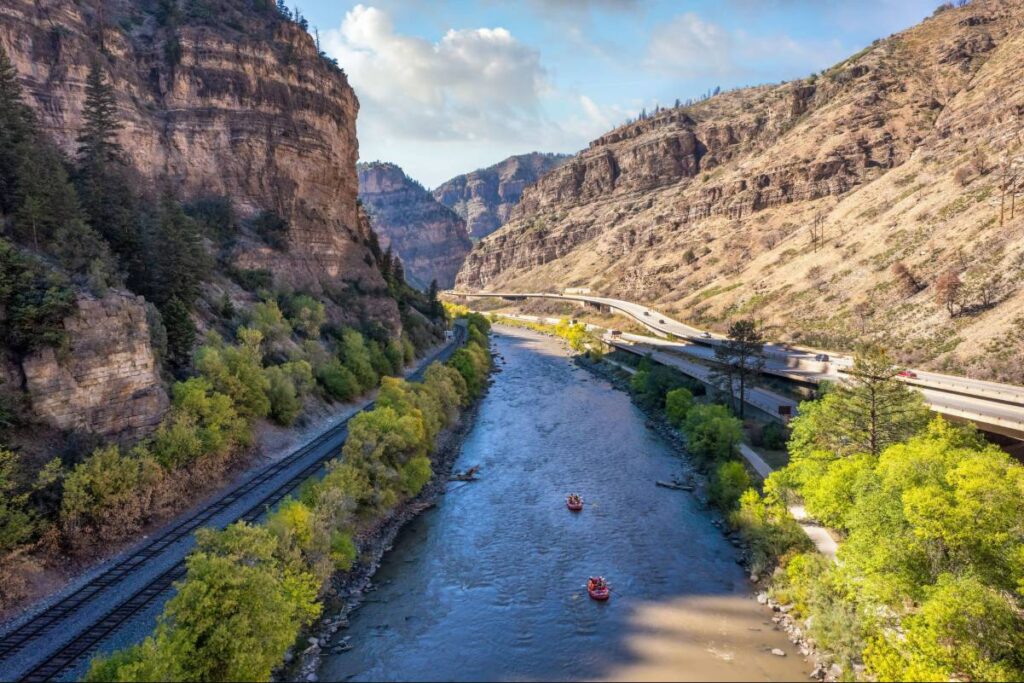
In response to prolonged drought conditions across the western United States, the federal government on Aug. 21 announced mandatory water cuts to the Colorado River for the Lower Basin states of California, Nevada and Arizona.
The mandatory cuts require the Lower Basin states to implement reductions of 1.25 million acre-feet in each year of the next two years. If the Lower Basin States implement their proposed sharing agreement, the reduction per state would be: Arizona: 760,000 acre-feet; California: 440,000 acre-feet; and Nevada: 50,000 acre-feet.
The cuts were announced by the U.S. Bureau of Reclamation, which issued the Record of Decision, establishing a 10-year framework for water management across the Colorado River basin, which entails updating operating guidelines every two years through 2036.
The plan is aimed at protecting Lake Mead and Lake Powell, which have suffered from years of drought and recently hit historical low water levels in recent weeks. In fact, the combined contents of Lake Powell and Lake Mead have not been this low since before Lake Powell began filling following the closure of the gates at Glen Canyon Dam in 1963, USBR said.
The broad framework released by Bureau of Reclamation will be used to develop future operational guidelines for the two reservoirs.
According to Fitch Ratings, the cuts will increase costs for water utilities in those Lower Basin states more acutely than the Upper Basin states (Colorado, New Mexico, Utah and Wyoming).
Fitch Ratings does not anticipate near-term ratings pressure on affected utilities given stored supplies and the ability to implement additional conservation measures. However, rating pressure could emerge should secondary supplies dwindle and if feasible alternative supplies are not developed. Higher costs incurred to develop new supplies will pressure margins over time if utilities are unable or unwilling to pass through costs to customers via rate increases.
Lakes Mead, Powell drop to record lows within a week
The federal government stepped in after talks among the seven Basin states about permanently reducing Colorado River water use failed to result in new operating parameters. Water management agreements governing Colorado River operations expire at the end of 2026. Under federal law, the USBR has the responsibility for managing Colorado River operations. Litigation is already underway disputing the post 2028 allocations.
According to Fitch, water utilities in the Basin states have already incurred higher costs stemming from the development of alternative water supplies. The pace of future cost increases may continue to diverge between the Upper Basin states and the Lower Basin states depending on subsequent operating plans. The plan is more burdensome on the Lower Basin states given the proportionally higher cuts. Additional investment in alternate supplies will drive capex and, likely, debt burdens higher.
Over the next three to five years, an inability to secure supply to meet ongoing demand would likely weaken some utilities’ operating risk profiles, potentially negatively affecting credit quality.
For some water utilities, particularly in Arizona, further cuts to water allocations could lead to additional rate or property tax increases to cover fixed costs and capital costs associated with development of new water supplies.
Arizona already made significant cuts under the 2019 Colorado Drought Contingency Plan. The largest was absorbed by the Central Arizona Water Conservation District (CAWCD; AA/Stable), which transports water to central and southern Arizona via the Central Arizona Project. In recent years, CAWCD raised rates and property taxes due to ongoing conservation and mitigation efforts by its member agencies, which participate in voluntary and compensated reductions.
Fitch’s rating commentary has noted that some ratings, all located in Arizona, are unlikely to move higher unless actions at the federal and/or state level provide greater long-term certainty around water supply.
According to Fitch, utilities will need to continue to develop additional supply strategies. These may include large-scale wastewater recycling (i.e., direct or indirect potable reuse), desalination, conservation, additional storage and/or groundwater replenishment.
As Fitch also noted, the City of San Diego and the Metropolitan Water District of Southern California (MWD) have advanced water treatment programs underway. The San Diego County Water Authority (CWA) also completed a seawater desalination plant 10 years ago that provides about 9% of its supply.
The Colorado River supplies about 20% and 66% of the water delivered by the MWD and the CWA, respectively. The supply diversification initiatives undertaken by CWA resulted in significant rate increases and excess supply in recent years, some of which it recently agreed to sell to two large Southern California wholesalers.
Source/s: Fitch Ratings; U.S. Bureau of Reclamation








Leave a Reply