
By Steve Cooper
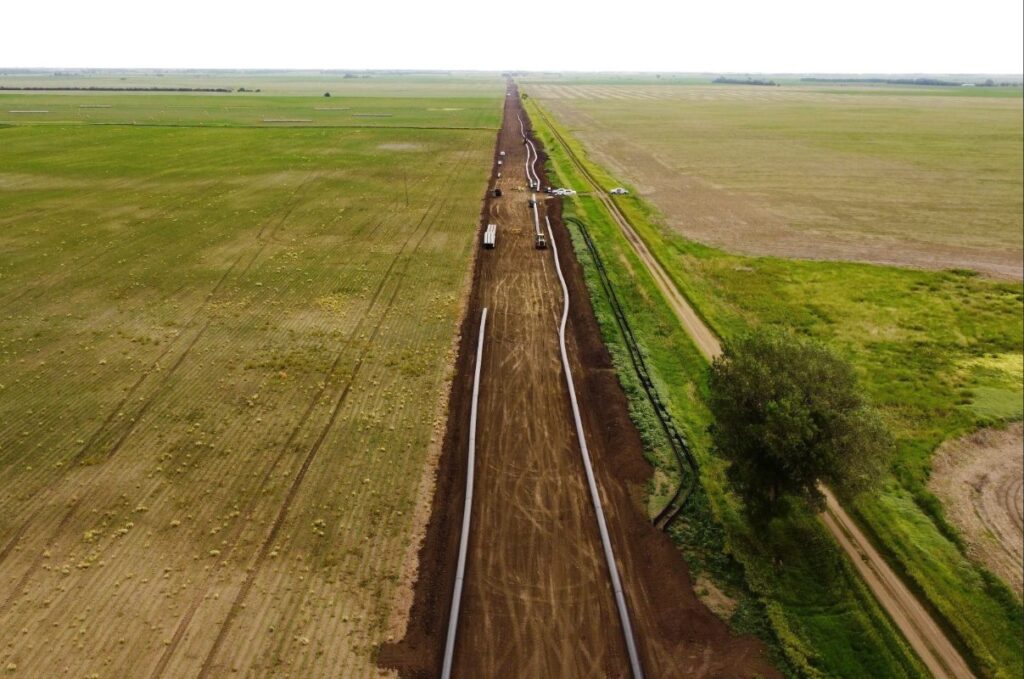
The Randall Regional Waterline Project will provide a high-capacity potable water transmission line that stretches 72 miles across the prairie in southeastern South Dakota.
The new pipeline will enable the Randall Community Water District (RCWD) in Lake Andes, South Dakota, to supply reliable drinking water from the Missouri River to two of RCWD’s existing customers – the Aurora-Brule Rural Water System and the Davison Rural Water System, as well as the City of Mitchell, South Dakota.
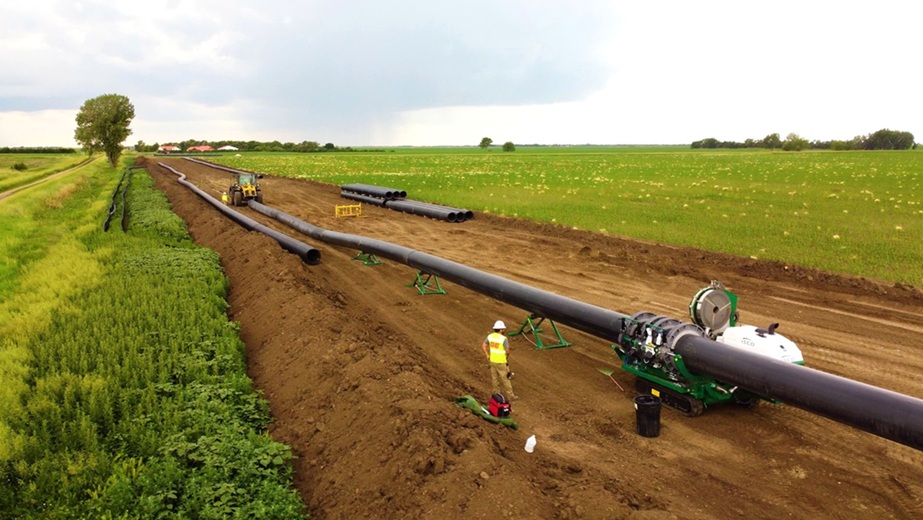
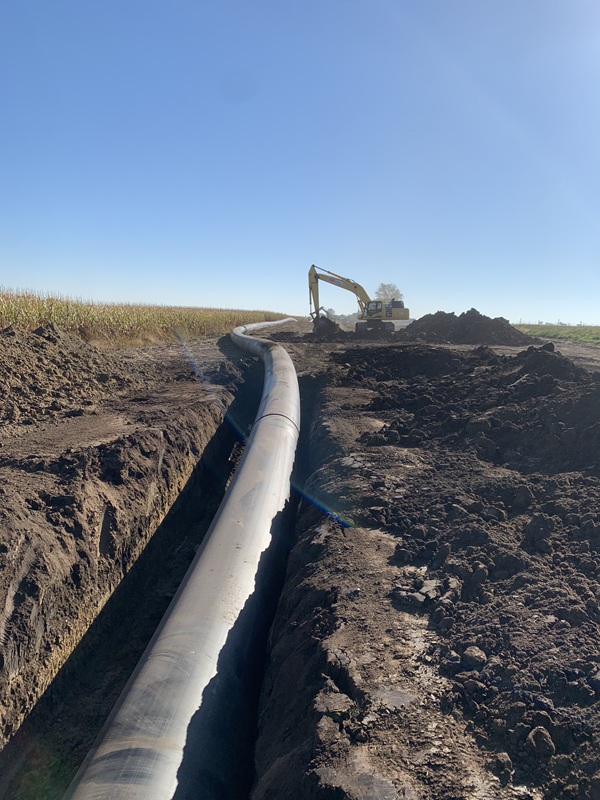
More than 380,000 ft of 30-in. DR 13.5 high-density polyethylene (HDPE) pipe made by Pipeline Plastics (Westlake, TX) is being used in what is being tagged as the largest single-phase HDPE pipeline project in the history of North America.
HDPE pipe with other pressure ratings is also being used. It was named the Potable Water Project of the Year by the Municipal & Industrial Division of the Plastics Pipe Institute, Inc. (PPI), the major North American trade association representing the plastic pipe industry.
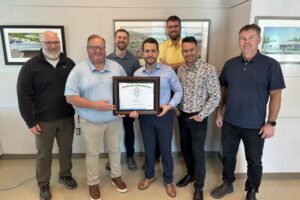
PPI Member Companies Pipeline Plastics, LLC (Westlake, TX) and ISCO Industries, Inc., (Louisville, KY) a major distributor of HDPE pipe and accessories that also provided technical assistance to RCWD, along with the pipeline design-build team of Hausmann Construction and Short Elliot Hendrickson, received the award during the association’s annual meeting in May 2026.
Continually increasing water demand and drought conditions are critical issues facing agricultural producers and municipalities across the state. Studies confirmed that local water supplies will not be able to meet those demands. This insufficient water supply hinders population growth and stagnates economic development. Additionally, for farmers and ranchers who need to replace ageing wells with new ones, the cost would be from $20,000 to as high as $100,000. This new pipeline will enable them to readily connect to a reliable system.
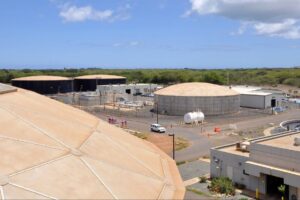
The project begins at the RCWD Platte Treatment Plant near Platte with significant upgrades occurring to its existing water treatment facilities. The project continues with new water pipeline construction from the Platte Tank Farm southwest of Platte and routes east and north to an existing storage site south of Stickney. The work continues with new water pipeline construction from the Stickney storage site to a service connection site near Mitchell.
“We did a bit of a futuristic planning for the water needs in the region” stated Scott Pick, general manager, RCWD. “We had a sizable community for South Dakota, the City of Mitchell, looking at its options for opportunities for water. They were looking to create a redundant source. They already had a contract with the rural water system and approached us as the backup source. The two other rural water districts we serve, Davison Rural Water and the Aurora-Brule Rural Water System, said they absolutely did have a future need for water. The City of Mitchell wanted 3,500 gallons a minute, Davison 500 gallons a minute and Aurora-Brule wanted 200 gallons a minute, and we designed that pipeline with those numbers in mind.” The project is appropriately named ‘Connecting Neighbors.’
RCWD provides water to six counties in South Dakota. The infrastructure project also includes treatment plant upgrades and expansion, associated water storage, pumping, and infrastructure components. The massive, complex project is being overseen by consulting, engineering and construction management firm Pinpoint Corporation (Brookings, SD).
With the needs determined and water supply agreements in place, the missing link was the funding. This was provided by a national catastrophe. “It took an event and the magnitude of money that was filtered into the economy from the COVID crisis,” Pick said.
“Our state received a significant amount of money. I think it was $600 million, for the state from the American Rescue Plan Act. We applied for and were eligible for right in the neighborhood of $20 million. So, during 2023 the dialogue was reopened and the project went from maybe a concept of a rainbow and hope to where we found the pot of gold.”
There was also support from the state for the South Dakota rural water project. Gov. Larry Rhoden wrote, “Access to clean, reliable water is foundational to the success of our communities, families, ag industry, and economy as a whole. During the Noem-Rhoden Administration, we invested hundreds of millions of dollars into modernizing our water infrastructure across the state, and we will continue to prioritize strong, sustainable water systems for future generations. I am grateful for the Randall Community Water District’s continued leadership in advancing these projects.”
At first, the plan called for a 24-in. diameter pipeline using the design-build process.
“We interviewed five companies,” Pick said, “and also asked ’What if we upsize that project from 24-in. pipe to 30-in. pipe?’ Then we looked at those numbers. And thankfully, our numbers for the 30-in. did not make a significant increase in the budget that made it insurmountable. It made it achievable. Plus, it’s a hundred-year-value of pipe so we’re not going to have to worry.”
The Hausmann Construction, Inc. (Lincoln, NE) – General Excavating (Lincoln, NE) Joint Venture, in collaboration with Short Elliott Hendrickson Inc. (SEH) (St. Paul, MN), is providing design-build services for the regional high-capacity water transmission line. Hausmann was also awarded the construction manager at risk contract to complete the Platte Treatment Plant Improvements that will add eight million gallons to RCWD’s capacity. ID8 Architecture provided architectural design services for the treatment plant building addition.
“We broke ground last June (2025),” Pick said, “with a 30-in. pipeline of 72 miles of pipeline, going from the Missouri River to what we call our Stickney Tank, and from our Stickney Tank to Mitchell. It’s kind of in 35-mile increments.
“So, the partnership started a few years ago with a relationship with ISCO when we began to look at using HDPE pipe. The company provided such ingenuity and a point of reference for us and their huge amount of intelligence in HDPE, plus the fact we could fuse the pipe. And then one of the greatest things happened, the pipe manufacturer, Pipeline Plastics, opened a plant in Belle Fourche, South Dakota, and that’s where the pipe was manufactured.” Pipe was also produced in Pipeline’s Texas and North Carolina plants.
The new plant provided a benefit aside from being able to deliver on a just-in-time schedule from a nearby location. The pipe sections were able to be made in lengths up to 60 ft, which are permitted for intrastate transportation. This meant fewer truck trips, which reduced the carbon footprint, and also fewer joints to be fused, increasing productivity. Fifty-three-foot-long sections of HDPE pipe were also used.
“We would have probably looked at ductile iron or maybe fusible PVC,” Pick explained. “But ductile iron has a whole modality of soils that can cause it to pit. You got to wrap everything. HDPE is the only reason we’re getting done as quickly as we can because we were able to go to 60-ft joints. And the fusion process is just uniquely different. In the PVC world, when the joint comes together, the first leak you find is whether the gasketed joint didn’t fit correctly.”
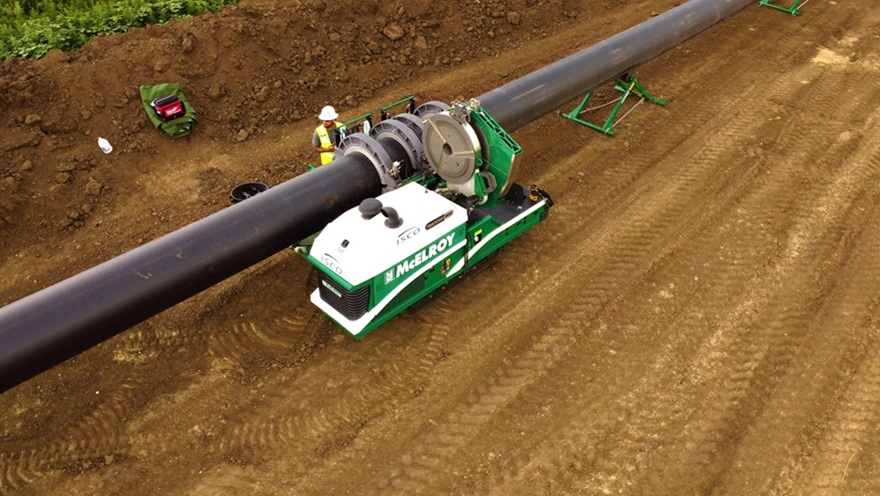
“High-density polyethylene pipe has been used for municipal and industrial water applications for almost 50 years,” explained Camille George Rubeiz, P.E., F. ASCE, co-chair, HDPE Municipal Advisory Board (MAB), and vice president for PPI’s Municipal & Industrial Division. “HDPE pipe’s heat-fused joints create a leak-free, self-restraint, monolithic pipe structure. The fused joint will also eliminate infiltration into the pipe and exfiltration into the environment. HDPE pipe has other benefits including chemical, abrasion, fatigue, seismic and corrosion resistance, and is designed for water and wastewater applications meeting the latest AWWA C906 and ASTM F714 standards.”
“Regardless of population size, every resident deserves access to safe, high-quality drinking water,” stated PPI President David M. Fink. “And the HDPE pipeline is the most cost-effective way to do that. Countless rural and mid-sized communities nationwide face these same problems, but there is a solution at hand, just as RCWD found.”
“A key driving force behind improving our nation’s water is the Congress’ active program to protect drinking water and modernize the aging water infrastructure that includes the State Revolving Fund, which is being utilized as part of the funding for this $110 million project along with a $22.4 million American Rescue Plan Act grant.
“Looking to the future, additional water will allow the City of Mitchell and the entire region to supply agriculture producers, new industries, businesses, and homes with ample water.”
Randall Water’s Pick summed up the on-going job. “So, without a doubt, when somebody asks, ‘What was the most significant thing?’ ISCO, HDPE pipe coming from Pipeline’s new, nearby plant, and putting all their wizardry, their evolutionary thought process together to say, ‘Yes, we can provide the product. Yes, it will be there on time, and it’s going to get done, and you will never have to worry in the next hundred years of monumental leaks.’ It’s just a great product.”
Additional information can be found at plasticpipe.org/municipalindustrial.
Steve Cooper has reported on numerous infrastructure projects for several decades. Based in New York, he has traveled extensively to conduct on-site news interviews with professional engineers, contractors, government officials and representatives of major companies supplying the industry. He can be reached at steve@scacommunications.com.







Leave a Reply