

A new analysis from global water market data firm Bluefield Research said U.S. federal water infrastructure funding is set to plummet roughly 63% between fiscal year 2026 and fiscal year 2027, dropping from $23.4 billion to an estimated $8.6 billion.
But Bluefield said there’s more to the story behind the anticipated decline.
The report, titled The U.S. Federal Funding Cliff: Sizing the Decline and Mapping the Exposures for States and Utilities, draws on Bluefield’s project-level analysis of 53,000 projects totaling $136 billion across four federal water funding programs: the State Revolving Fund (SRF), the Water Infrastructure Finance and Innovation Act (WIFIA), the American Rescue Plan Act (ARPA), and the Infrastructure Investment and Jobs Act (IIJA).
As the analysis points out, the four programs were created for different purposes and under different policy conditions, and each are operating on a different timeline.
As standing funding authorities, the SRFs and WIFIA will continue indefinitely as long as Congress funds them. ARPA and IIJA, by contrast, were implemented with fixed deadlines, and the fiscal year 2027 “cliff” Bluefield mentions reflects the simultaneous expiration of both funding streams.
Bluefield points out these four notable takeaways pertaining to the programs.
- SRF programs center on a federal-state partnership that shifted water financing toward state-managed revolving funds. They continue as standing sources of low-interest loans and grants to local utilities for as long as Congress authorizes and funds them.
- WIFIA is a low-cost federal lending program, also a standing authority subject to ongoing appropriations, intended to leverage other sources of capital for large projects.
- ARPA provided emergency fiscal relief during the COVID-19 pandemic on a fixed, now-expiring timeline.
- IIJA delivered an unprecedented, time-limited $55 billion infusion of federal capital into the water sector starting in 2022, with more than 80% of it channeled through the established state SRF programs rather than distributed as a standalone funding stream.
“At over $130 billion, these programs have become major contributors to U.S. water infrastructure investment,” said George Prounis, data and insights manager at Bluefield Research. “But they were never designed to do the same thing, and each faces its own challenges.”
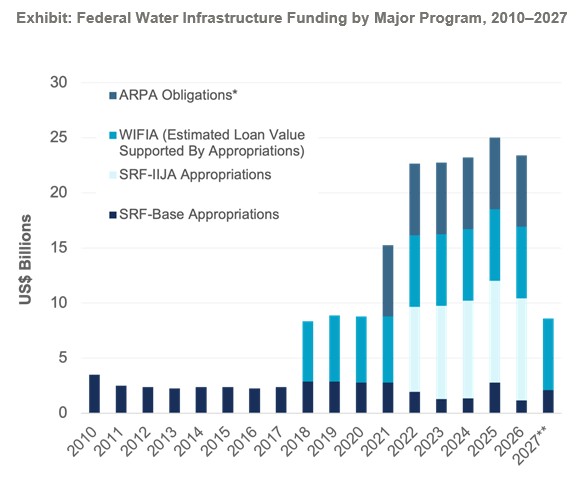
Bluefield’s analysis looks at the expected funding decline from a broad perspective. According to the Congressional Budget Office, in 2023, state and local governments accounted for 96% of water infrastructure investment in the United States, while the federal government contributed just 4%.
According to the Congressional Budget Office, state and local governments accounted for 96% of U.S. water infrastructure investment in 2023, compared with 4% from the federal government. Therefore, 2026-2027 marks the end of a five-year federal surge rather than a comparable contraction in overall water infrastructure investment.
Bluefield’s analysis presents several key points about the four programs and the outlook on their funding potential in the near future.
For instance, despite the sharp federal decline expected between fiscal years 2026 and 2027, the pipeline of SRF funding already authorized under the Infrastructure Investment and Jobs Act will continue supporting projects well beyond 2027. Bluefield’s analysis of the current award pace suggests IIJA-backed SRF funding will continue reaching water utilities into the early 2030s.
The U.S. Federal Funding: Sizing the Decline and Mapping the Exposures for States and Utilities, utilizes Bluefield Research’s federal funding project databases to quantify the scale, structure and geographic distribution of federal water infrastructure investment since 2021.
The full data insight is available for purchase and can be downloaded immediately from Bluefield’s website.
To read more on the key findings, a full press release can be found here.









Leave a Reply