

Population-Band Metrics, Ohio Opportunity and the Next Wave of Water Utility Collaboration
By Gregory M. Baird
As Ohio’s water community gathers for the One Water Conference and more counties evaluate regional water and sewer feasibility, regionalization is moving from a theoretical governance option to a practical shared capability strategy: one designed to reduce risk, control future cost exposure, strengthen compliance, improve workforce depth, support infrastructure renewal, and improve long-term service resilience.
This article builds on Black & Veatch’s recent Water Finance Conference presentation, Potential for Consolidation/Regionalization/Privatization, which introduced the companion draft white paper, National Cost-Benefit Estimate: Water Utility Regionalization & Consolidation by Population Band, as the basis for the national cost-benefit metrics cited throughout the article. In this context, “capability” does not mean treatment capacity alone. It refers to the organizational, technical, managerial, financial, workforce and implementation strength needed to deliver reliable utility service over time.
Examining utility finance, asset management, planning, governance, stakeholder engagement and infrastructure delivery provides a multidisciplinary lens for identifying where regionalization can create measurable value. This can be done while helping communities protect local interests, manage customer impacts and improve long-term service reliability.
- Water utility regionalization can help communities manage compliance, PFAS, workforce, infrastructure, affordability, and rate-pressure challenges.
- The strongest per-customer regionalization benefits are often found in systems serving fewer than 10,000 people.
- State SRF programs can support regionalization feasibility studies before major infrastructure investments are made.
- Regionalization should be evaluated as an integrated utility strategy that connects engineering, finance, governance, rates, capital planning, stakeholder engagement, and implementation.
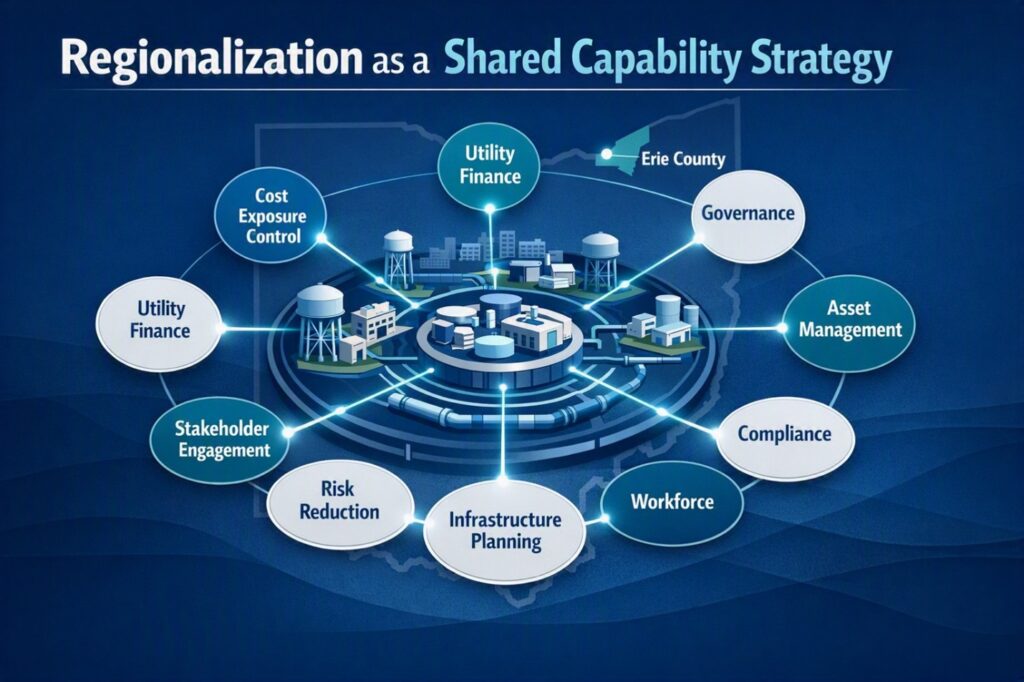
The central finding is that regionalization is no longer only a response to distressed or failing systems. It is increasingly a proactive tool for reducing risk, controlling future cost exposure, improving affordability, strengthening compliance, deepening workforce resources, and supporting long-term utility resilience. For systems serving fewer than 50,000 people, the companion white paper estimates a moderate annual opportunity of approximately $0.42 billion to $1.63 billion in avoided costs and productivity value, equal to roughly $6.3 billion to $24.3 billion in 20-year real net present value.
The white paper analyzed all 50 states using a population-band screening framework; this article highlights selected state examples to show how the national metrics can be translated into state- and county-level feasibility discussions. These values are planning-level cost-avoidance and productivity metrics—not guaranteed customer bill reductions — and may be realized through avoided duplicate capital projects, slower operating cost growth, improved financing access, workforce efficiencies, lower compliance costs, stronger asset lifecycle management, and shared technology platforms.
One reason regionalization is gaining attention is the growing list of market pressures facing utilities. The conference presentation identified climate impacts, resilience and reliability, aging infrastructure, funding constraints, increasing operations and maintenance costs, asset lifecycle management challenges, workforce retirements, regulatory requirements, cybersecurity concerns, and rising customer expectations as major drivers affecting the water sector. These pressures affect utilities of all sizes but are particularly difficult for smaller systems to address independently.
Black & Veatch’s 2026 Water Report reinforces the same sector wide pressures. Based on survey input from more than 600 U.S. water industry stakeholders, the report identifies aging infrastructure, funding shortfalls, regulatory and compliance requirements, treatment and water quality concerns, resilience needs, and collaborative delivery as defining issues for the sector. The report also underscores the rate-pressure environment facing utilities, with funding and capital availability cited more often than expanding regulation as the top overall challenge, signaling that cost pressure has become a core driver of utility decision-making.
PFAS reinforces why shared capability matters. Black & Veatch’s PFAS cost modeling work for AWWA shows that compliance with emerging drinking water standards can require substantial capital and operating investment across utilities of all sizes. While the regulatory obligation applies broadly, the per-customer burden is often greatest for smaller systems with limited rate base, staff capacity, procurement leverage, and technical specialization.
The fragmented structure of the U.S. water industry amplifies these challenges. Approximately 85% of U.S. water utilities are owned or controlled by local governments, and most serve relatively small populations. EPA data shows that systems serving fewer than 10,000 people represent the overwhelming majority of community water systems, yet these same systems often face the greatest technical, managerial and financial capability constraints.
Why Small Water Systems and Population Bands Matter for Regionalization
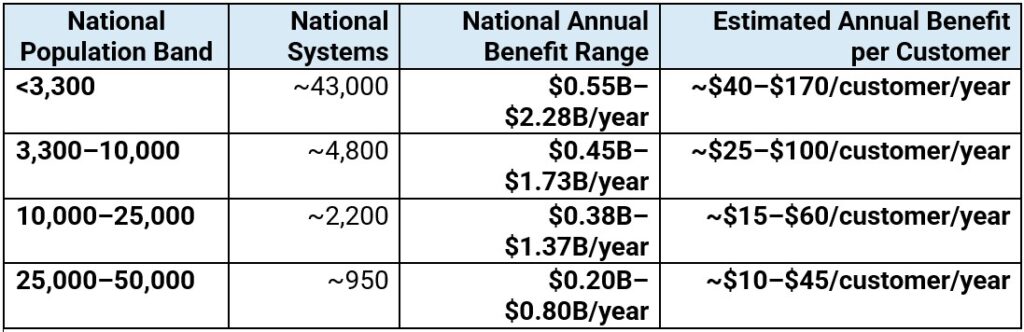
The population-band analysis shows why small systems are central to the regionalization discussion. More than half of U.S. community water systems serve fewer than 500 people, and roughly 81% serve fewer than 3,300 people. These systems must meet many of the same regulatory, operational, cybersecurity, asset management, and customer service expectations as larger utilities, but with fewer customers to spread fixed costs and often less staff depth, revenue flexibility, and technical specialization. As a result, they are more vulnerable to compliance failures, deferred maintenance, operator shortages, emergency response gaps, and affordability stress.
Benefits differ by population band because core utility functions — certified operators, compliance reporting, billing, asset inventories, emergency response, capital planning, and financing — do not scale down easily. Regionalization can convert isolated obligations into shared capabilities by giving smaller systems access to operators, engineering support, purchasing power, asset management tools, emergency response resources, and stronger financial planning. The objective is not simply to reduce the number of systems; it is to reduce the number of unsupported systems.
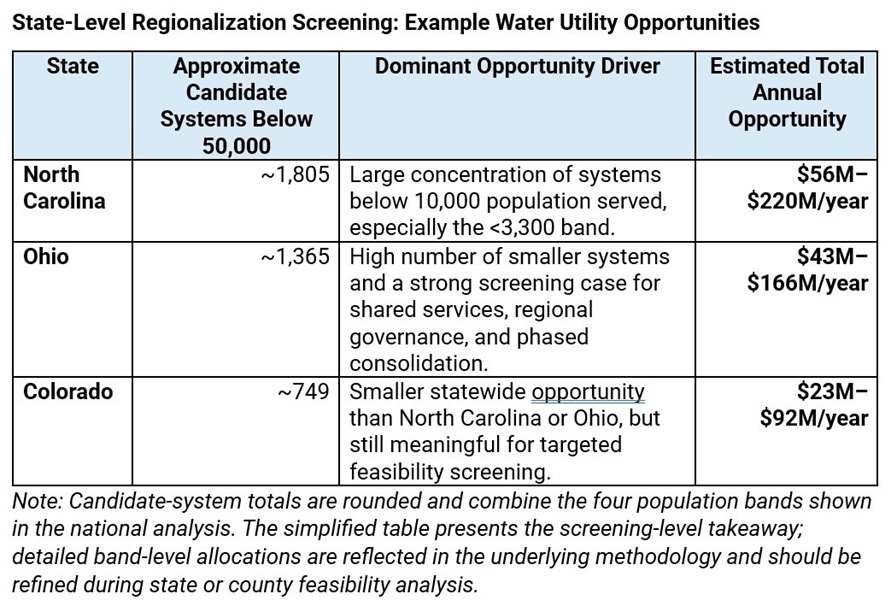
To develop state-level screening estimates, the national benefit ranges were allocated to each example state based on that state’s share of candidate systems within each population band. This approach assumes that, for planning purposes, a state with a larger share of the national systems in a given band would represent a proportionally larger share of the national cost-avoidance opportunity for that band. The method is intended only as a screening-level allocation of the national estimate. It is not a project-specific forecast and does not account for local infrastructure proximity, system condition, governance feasibility, existing debt, rate structures, workforce needs, regulatory drivers, or community willingness to participate.
The resulting state totals should be interpreted as directional planning ranges that help identify where more detailed regionalization feasibility studies may be warranted.
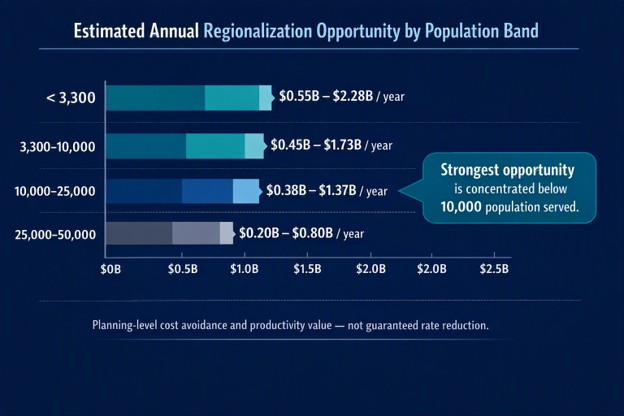
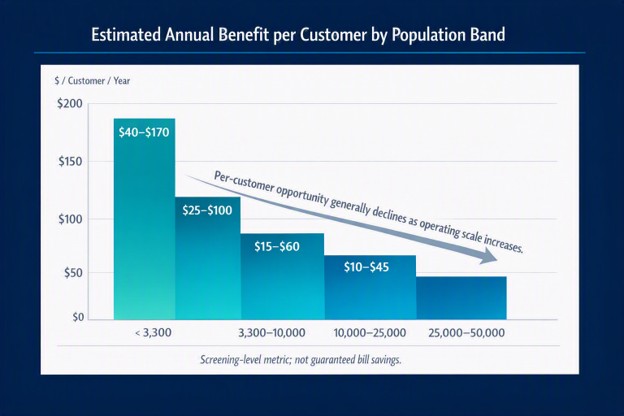
While Figure 2 shows the aggregate annual opportunity by population band, Figure 3 translates those same planning-level benefits into a per-customer metric. This distinction is important because larger systems may show higher total dollar values, while smaller systems often show greater per-customer value due to the fixed cost burden of staffing, compliance, administration, technology, emergency response, and capital planning. Together, the two figures show both the national scale of the opportunity and why the business case is often strongest for smaller systems.
Why Ohio Water Utility Regionalization Is a Timely Opportunity
Ohio is timely because the state has both the need and the opportunity: a fragmented utility landscape, measurable screening-level economic potential, active sector attention through One Water, and specific county-level interest in regionalization feasibility. That combination makes Ohio a practical proving ground for moving regionalization from concept to implementation.
Ohio combines a large number of smaller systems with an estimated $43 million to $166 million per year in planning-level regionalization and consolidation opportunity. That range is not a forecast of immediate bill savings; it indicates the scale of resources that could potentially be redirected toward compliance, asset renewal, capital optimization, workforce capability, emergency response, technology modernization, and long-term rate stabilization.
The timing is especially relevant for Ohio’s One Water audience. The conference brings together utility leaders, regulators, operators, engineers, consultants, and technology providers around the same themes that determine whether regionalization succeeds: governance, affordability, regulatory compliance, infrastructure renewal, workforce succession, resilience, and stakeholder trust. In that context, regionalization should be framed not as a loss of local identity, but as a disciplined process for testing whether shared capability can produce stronger service outcomes than fragmented stand-alone delivery.
County-level regionalization feasibility studies illustrate why this discussion matters. A regionalization feasibility study requires more than engineering analysis alone; it must integrate governance models, existing assets, utility finances, cost-of-service impacts, debt and capital planning, operating agreements, workforce capability, regulatory obligations, stakeholder priorities, and implementation risk.
That framework also aligns with the objectives reflected in recent Ohio county-level regionalization discussions. Common goals include reducing treatment, infrastructure, maintenance, purchasing, and labor costs; improving long-term planning and service reliability; stabilizing and equalizing rates without creating negative impacts for current customers; supporting priority projects and future economic development; and improving operational decision-making.
These goals reinforce why a feasibility study should not begin with a predetermined answer. It should test a continuum of options — from shared services and joint procurement to coordinated wholesale agreements, regional treatment or conveyance strategies, authority or district models, and full consolidation — against transparent measures of cost, risk, governance, rate impact, asset condition, workforce implications, regulatory readiness, stakeholder acceptance, and implementation feasibility.
A regionalization feasibility process should also normalize capital project information across participating systems so projects can be aligned and compared on a consistent basis. This includes standardizing project definitions, cost estimates, timing, risk reduction value, regulatory drivers, asset condition, service reliability benefits, watershed or sewer shed relevance, funding eligibility, and customer impact, allowing decision-makers to prioritize projects that provide the greatest regional benefit while reducing duplication and improving long-term affordability.
Key Takeaways for Water Utility Regionalization and Consolidation
- North Carolina shows the largest opportunity among the three, with an estimated $56M–$220M/year in potential regionalization/consolidation value.
- Ohio is also a high-opportunity state, with roughly $43M–$166M/year in potential annual benefits.
- Colorado has a smaller but still meaningful opportunity, estimated at $23M–$92M/year.
- In all three states, the largest dollar contribution comes from systems under 10,000 population served, especially the <3,300 band.
- These estimates represent technical cost-benefit potential, not guaranteed customer rate reductions. Savings may be reinvested into compliance, asset renewal, PFAS/LCRR response, workforce capability, resilience, or technology modernization.
Regionalization is fundamentally about shared capability, not treatment capacity, system size, or ownership structure. The goal is to reduce the number of unsupported utilities by creating organizations with stronger technical expertise, compliance support, financial strength, asset management maturity, and emergency response capability.
A key driver behind this shift is the infrastructure funding challenge. Many utilities do not set aside sufficient reserves for asset renewal, creating hidden liabilities that later appear as emergency repairs, regulatory violations, service interruptions, or large capital projects.
Regionalization can address these challenges through economies of scale. Larger operating platforms can reduce administrative costs, improve workforce efficiency, enhance purchasing power, and strengthen compliance performance. The strongest benefits occur among systems serving fewer than 10,000 people and begin to flatten as utilities approach approximately 45,000 to 60,000 population served.
The Water Finance Conference presentation summarized the economic case through four themes: scale, compliance, shared capability and affordability. Regional platforms allow utilities to share operators, engineering expertise, GIS and asset management systems, SCADA support and specialized regulatory staff, while better financing access and reduced duplication can help moderate future rate increases.
The national opportunity may be significant. The white paper estimates that a moderate adoption scenario could create roughly $0.4 billion to $1.6 billion annually in avoided costs and productivity value for systems below 50,000 population served, or $6 billion to $24 billion in 20-year net present value. These figures are not direct bill reductions; they represent resources that can support compliance, asset renewal, cybersecurity, resilience, workforce development and rate stabilization.
Workforce capability is one of the most compelling drivers. Regional platforms can support shared operators, compliance specialists, asset managers, technology staff, cybersecurity experts, engineers and financial analysts — expertise many small utilities could not support independently.
The affordability challenge further strengthens the case. AWWA’s Beyond the Replacement Era estimates drinking water infrastructure needs of $2.1 trillion to $2.4 trillion through 2050 and an annual funding gap of roughly $56.6 billion. Regionalization cannot eliminate this gap, but it can help utilities stretch limited resources and reduce upward pressure on rates.
In the context of AWWA’s 2050 infrastructure outlook, regionalization should be viewed as one pathway to long-term utility sustainability, helping communities spread fixed costs, strengthen technical and financial capability, improve capital prioritization, and reduce upward pressure on rates over time.
Importantly, regionalization should not be confused with privatization. Regionalization focuses on governance, service delivery, and organizational scale. A regional organization can remain entirely publicly owned and operated through interlocal agreements, regional authorities, special districts, or public-public partnerships. The white paper emphasizes that concerns about local control, governance representation, rates, asset ownership, and legacy debt must be addressed transparently for regionalization efforts to succeed.
Workforce capability is one of the most compelling drivers. Regional platforms can support shared operators, compliance specialists, asset managers, technology staff, cybersecurity experts, engineers and financial analysts — expertise many small utilities could not support independently.
The future of regionalization will likely involve a spectrum of approaches. Shared services and management regionalization frequently provide the most practical starting point because they improve workforce, compliance, emergency response, and technology capabilities without requiring asset transfers. Full ownership consolidation may be warranted where utilities seek larger benefits from integrated debt management, rate-base pooling, capital optimization, and retirement of duplicate infrastructure.
Ultimately, the question is no longer whether utilities face mounting pressures; it is whether fragmented utility structures remain the best way to manage them. Regionalization offers one pathway to build stronger, more resilient organizations capable of delivering safe, reliable, and affordable water service in an era of increasing complexity.
Summary of Key Findings on Water System Regionalization
Key Finding 1: Cost, Compliance, and Workforce Pressures Are Accelerating Regionalization Interest
Utilities face a convergence of aging infrastructure, regulatory requirements, workforce retirements, cybersecurity threats, rising operating costs, climate risks and customer expectations. These pressures are increasing the need for service delivery models that can reduce risk, control future cost exposure, and strengthen long-term utility resilience.
Key Finding 2: Fragmentation Creates Fixed Cost and Shared Capability Challenges
Approximately 85% of U.S. water utilities are owned or controlled by local governments, with most serving relatively small customer bases. Smaller systems often struggle to spread fixed costs, maintain specialized staff, fund regulatory requirements, and execute capital planning at the same level as larger utilities.
Key Finding 3: The Strongest Opportunity Is Concentrated Below 10,000 Population Served
The white paper finds that the strongest per-customer benefits occur in systems serving fewer than 10,000 people, where the fixed-cost burden is highest and workforce, compliance, financial, and asset management capability gaps are often most significant. Benefits generally begin to flatten as utilities approach approximately 45,000 to 60,000 population served.
Key Finding 4: National Benefits Are Significant but Should Be Treated as Cost-Avoidance Metrics
Under a moderate adoption scenario, the white paper estimates $0.42 billion to $1.63 billion annually in avoided costs and productivity value for systems below 50,000 population served, equal to roughly $6.3 billion to $24.3 billion in 20-year real net present value. Under full technical adoption, the modeled opportunity is approximately $1.6 billion to $6.2 billion annually. These benefits are not guaranteed bill reductions; they represent resources that may be redirected to compliance, asset renewal, cybersecurity, resilience, workforce development, and rate stabilization.
Key Finding 5: Shared Services Are Often the Practical Entry Point
Shared services, joint staffing, procurement, compliance support, technology platforms, emergency response coordination, and management regionalization can capture meaningful benefits without requiring immediate asset transfers or full governance restructuring. Full ownership consolidation may be appropriate where communities seek larger capital, financing, debt integration, or duplicate-facility retirement benefits.
Key Finding 6: Feasibility Must Compare Governance, Finance, Assets, Rates, Workforce, Watersheds, Sewer Sheds, and Implementation
A defensible regionalization feasibility process should compare governance alternatives, operating models, asset responsibilities, capital priorities, rate and customer impacts, workforce needs, watershed and sewer shed relationships, regulatory readiness, stakeholder acceptance, and implementation feasibility. The goal is not to predetermine a governance outcome, but to create a transparent decision framework for moving from interest to action.
Executive Takeaway: Regionalization as a Pathway to Long-Term Utility Sustainability
The central conclusion of the conference presentation and Black & Veatch Infrastructure Advisory’s supporting research is that the water sector should shift its focus from reducing the number of utilities to reducing the number of unsupported utilities. Regionalization should be viewed as a shared capability, risk reduction, and affordability strategy that helps utilities manage infrastructure, compliance, workforce, and resilience challenges before they become crises.
For Ohio utilities and counties evaluating shared service, regional governance, and consolidation models, the priority is a transparent, data-driven process that protects local interests while testing whether broader operating scale can produce stronger technical, financial, and managerial capability. Multidisciplinary regionalization expertise spanning utility finance, engineering, asset management, governance, stakeholder engagement, and implementation planning can help convert policy interest into practical, defensible decisions.
The call to action is clear: communities should not wait for regulatory pressure, emergency capital needs, workforce shortages, or affordability stress to force the regionalization conversation. National metrics show a meaningful planning-level opportunity for systems below 50,000 population served, with the strongest per-customer value concentrated below 10,000 population served. Regionalization can serve as both a state-level strategy for identifying priority markets, policy tools, watersheds, and sewer sheds, and a county-level strategy for evaluating shared services, regional governance, phased consolidation, customer impacts, and implementation pathways.
State environmental agencies can use this framework to shift from reactive oversight to proactive prioritization, with compliance and long-term utility sustainability as the primary goals. By combining population-band metrics with compliance history, affordability stress, capital needs, watershed and sewer shed conditions, and technical, managerial, and financial capability indicators, states can better focus SRF incentives, planning grants, technical assistance and regional alternatives analysis on the systems and regions where shared services or consolidation may deliver the greatest public benefit. SRF programs can also play a larger role in supporting regionalization feasibility studies before major infrastructure investments are made, giving communities a way to evaluate governance options, capital needs, rate impacts, affordability, regulatory compliance, and implementation pathways before committing to a specific project or service model.
Regionalization should not be framed as an engineering answer looking for a project or a financial answer looking for savings. It should be treated as an integrated utility strategy that aligns infrastructure, rates, governance, operations, capital priorities, stakeholder engagement and implementation around long-term community outcomes. This is where integrated infrastructure advisory and engineering expertise matters: regionalization requires the ability to connect technical feasibility, financial impacts, governance choices, rate methodology, capital priorities, public engagement, and implementation risk into one decision framework.
Utilities, counties, states, and regional partners should begin structured screening discussions now to identify where shared services, regional governance, or phased consolidation could reduce risk, control future cost exposure, improve watershed and sewer shed planning, and strengthen long-term service reliability. The next step is a transparent feasibility process that gives local and state decision-makers the objective information needed to compare governance options, quantify customer and community impacts, align capital priorities, evaluate financing and funding strategies, and define an implementation roadmap from concept to action.
Consistent with the Effective Utility Management framework, regionalization should be part of a continual improvement cycle: assess current performance, compare alternatives, set measurable service and financial objectives, prioritize capital needs, engage stakeholders, implement the preferred pathway and measure results over time. The strongest regionalization efforts will not simply change governance structures; they will improve utility performance, financial viability, infrastructure strategy, workforce capability, customer outcomes, and watershed or sewer shed sustainability.
These issues will continue to shape the national water finance conversation heading into the 2027 Water Finance Conference, August 3–4, 2027, at the Cleveland Metropolitan Conference Center in Cleveland, Ohio.
As utilities, counties, state agencies, SRF programs, and regional partners evaluate how to fund infrastructure, manage affordability, address PFAS and compliance costs, and strengthen long-term utility sustainability, regionalization feasibility studies should be part of the discussion. The conference provides a timely forum for moving the conversation from broad policy interest to practical financial, governance and implementation strategies.

Greg Baird, MPA, is a Principal Utility Financial Consultant with Black & Veatch. A former utility CFO, he specializes in long-term utility planning, infrastructure asset management and capital funding strategies for municipal utilities in the United States. He is a frequent contributor to Water Finance & Management.
References and URLs
- Black & Veatch 2026 Water Report
- Black & Veatch PFAS compliance cost white paper
- Black & Veatch / AWWA PFAS cost model project
- AWWA Beyond the Replacement Era report
- EPA Effective Utility Management Primer
- EPA Effective Water Utility Management Practices
- EPA EFAB Funding Strategies to Promote System Regionalization
- Water Finance Conference









Leave a Reply