
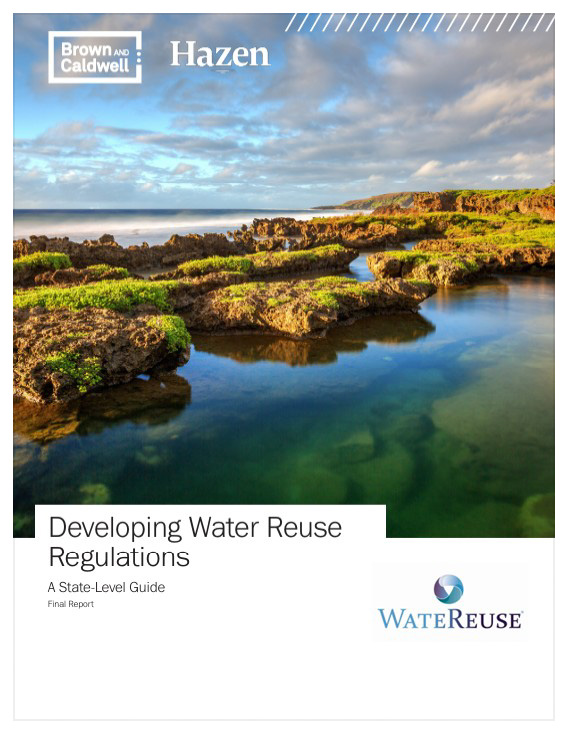
The WateReuse Association (WateReuse) has released a new guidebook to help utilities, regulators and industry practitioners develop water reuse regulations tailored to state-specific needs.
As water reuse continues to grow in importance nationwide, many states are seeking practical tools to navigate the complex, often non-linear process of establishing or updating regulations. The new document, Developing Water Reuse Regulations: A State-Level Guide, addresses this need by offering a flexible framework to support decision-making and stakeholder engagement throughout the rulemaking process.
“Smart regulations create markets and drive innovation,” said Bruno Pigott, executive director of the WateReuse Association. “Our members and partners identified a need for practical, accessible guidance on water reuse regulations, and this guide delivers. It presents regulatory approaches relevant to every state and every type of reuse, helping communities work with regulators to develop implementable, health-protective solutions.”
Developing Water Reuse Regulations: A State-Level Guide was funded by WateReuse, with additional financial and technical support from the Association of Metropolitan Water Agencies (AMWA), American Water Works Association (AWWA), National Association of Clean Water Agencies (NACWA), and Water Environment Federation (WEF). Brown and Caldwell led the development of the guide in collaboration with Hazen and Sawyer (Hazen). Brown and Caldwell and Hazen, both WateReuse members, also offered in-kind support. This broad coalition demonstrates an industry-wide commitment to advancing water reuse as a critical component of sustainable water management in the U.S.
Carollo releases guidebook on AI adoption for potable reuse
The guide is approximately 90 pages and features three main sections: types of rulemaking pathways, phases of regulatory development and strategies for supporting stakeholder engagement. Rather than prescribing one-size-fits-all solutions, it equips users with practical tools, real-world case studies and guiding questions to foster productive conversations and develop approaches tailored to individual state needs.
It also includes case studies from states such as California, Florida and Washington that highlight diverse regulatory approaches and lessons learned to help practitioners better understand how different pathways can be applied in practice.
More than 200 stakeholders across the country participated in industry workshops, meetings, and focus groups to develop the guide. These stakeholders represented utilities, regulators, consultants and partner organizations, bringing a wide range of perspectives to the process.
“South Carolina is a water rich state, but we also have our share of water challenges,” said Tricia Kilgore, Director of Technology and Innovation at Beaufort-Jasper Water & Sewer Authority, and a member of the project’s Technical Advisory Committee. “Our population is booming while our disposal options shrink. Saltwater intrusion is shutting down coastal wells, and this summer over half of our state is experiencing a severe drought. Water reuse is a valuable tool to address these challenges. I’m excited to use this guide in our effort to develop safe, workable regulations and unleash the potential of reuse in South Carolina.”
Diverse stakeholder feedback helped validate key concepts, refine the guide’s structure, and ensure the content reflects real-world challenges and opportunities facing those involved in water reuse rulemaking. Community leaders shared common challenges and opportunities shaping water reuse rulemaking across the country.
Developing Water Reuse Regulations: A State-Level Guide is available now at watereuse.org/guide. It is intended to serve as an evolving resource for the industry, with additional outreach, including webinars and conference presentations, planned to support adoption and ongoing collaboration.
Source: WateReuse Association








Leave a Reply