
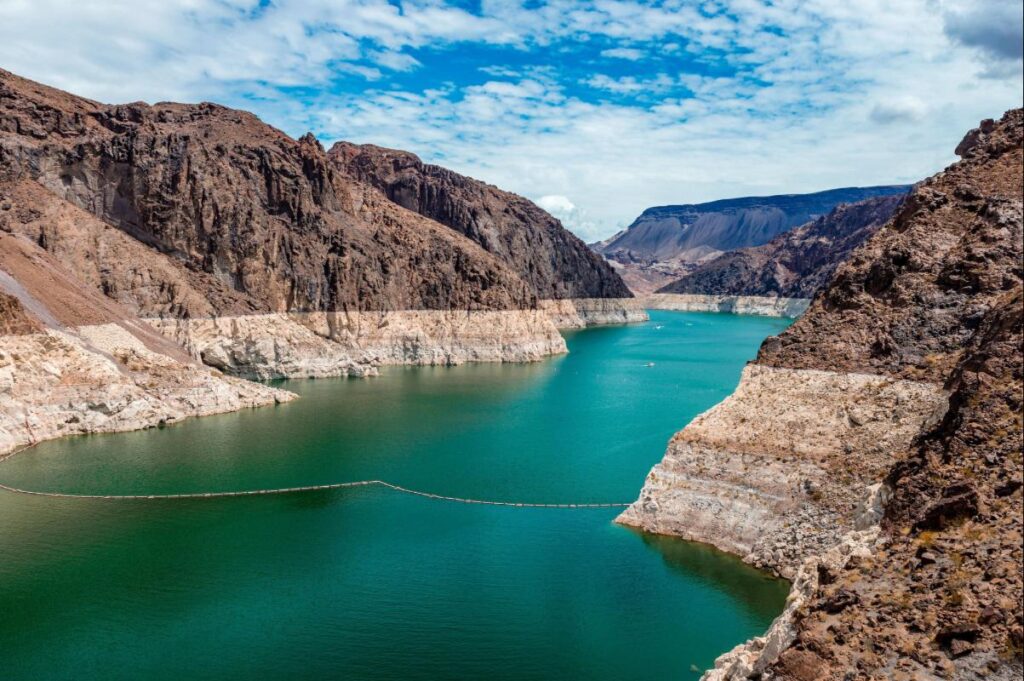
The two largest water reservoirs in the United States — Lake Mead in Colorado and Lake Powell, covering parts of southern Utah and northern Arizona — each hit record low water levels within a week.
In addition to being the largest water reservoirs in the United States, Lake Mead and Lake Powell are the two largest reservoirs in the Colorado River system, which flows through seven states and provides water to about 40 million people.
According to U.S. Bureau of Reclamation data, Lake Mead’s water level fell to 1,041.1 ft in July, its lowest recorded level in history. It’s more than 44 ft below the recorded level in January 2017 and about 190 ft below its full level.
Then in August, the water level in upstream Lake Powell hit 3,519.5 ft (as of Aug. 18). Lake Powell has dropped about 20 ft this year alone, according to an Associated Press report, which also noted that the lake is about 30 ft from being too low for turbines to produce hydroelectric power. The threshold to spin turbines at Lake Powell’s Glen Canyon Dam is 3,490 ft.
Earlier this year, Bureau of Reclamation said if Glen Canyon Dam drops below 3,490 ft, Lake Powell water releases would be only through the river outlet works, which could cause operational issues, uncertainty for users, downstream impacts, instability in regional power and water supplies, and a reduction in power generation.
A separate AP report on Aug. 8 noted that Lake Mead and Lake Powell are not the only struggling reservoirs. Of the 54 reservoirs monitored by Bureau of Reclamation, nine recently recorded their lowest levels in history, the AP noted.
The Colorado River and its reservoirs have dealt with dwindling water resources for decades, but recent climate conditions have only worsened the situation. A record-dry winter in the Rocky Mountain region that resulted in Colorado’s worst snowpack since 1941 has combined with high temperatures and persistent overuse, creating a perfect storm resulting in the depleted sources.
In July, the Bureau of Reclamation released a new proposal that would see mandatory cuts from the Lower Basin states of California, Nevada and Arizona. The three states could be forced to reduce water use by up to 3 million acres-ft annually though 2036 if the proposal is finalized.
More on the proposed restrictions can be found in this AP report from July 31.
Source/s: U.S. Bureau of Reclamation; Associated Press








Leave a Reply