

By Joseph Harmes
In 1969, when one of the fastest-growing counties in the United States was Suffolk in easternmost Long Island, N.Y., voters approved a $291 million referendum to finance its first large-scale wastewater project in acknowledgement that sewers were an environmental necessity. “Leakage from cesspools and septic tanks was reaching the drinking water supply, which, on Long Island, comes totally from subsurface wells. Leakage was polluting the Great South Bay and forcing the closing of shell fishing areas. Overflowing cesspools, a common problem in coastal areas with high water tables, were a threat to public health,” The New York Times observed.
It wasn’t to be. Allegations of fraud, corruption and coverups of substandard work triggered 12 federal investigations. Then, opponents of a local sewer tax hike attacked the project on the grounds it posed a bigger threat to the economic health of residents than the environmental exigency of sewers. The project stalled after its cost tripled and a federally financed study concluded that human wastes had been overemphasized as a source of pollutants. As one local official told The Times in 1978, “The sad thing is that as a result of this experience we may never be able to build more sewers, even in areas where they are really needed.”
Today, an estimated 1 million people on Long Island use septic systems or cesspools (underground containers for storing liquid waste and sewage) constituting one of the densest concentrations in the country. But, additional decades of their collateral damage have boomeranged septic/cesspool-to-sewer conversions backed by local, state and federal funding into action again.
From Bright Lights to Darker Times
Towns like the Incorporated Village of Patchogue became emblematic of this mounting plight.
Founded in 1664, it had utilized cesspools, septic and straight pipes along the Patchogue River and Great South Bay (called “the lifeblood of the village”) for most of its existence. Historically, riverbank mills proliferated and the seaport thrived with fisheries and boat building. The Long Island Railroad terminated at Patchogue marking its transformation into a popular tourist destination. Patchogue was one of the first 300 communities in the United States that were electrified. It built gravity sewers and a rudimental wastewater treatment plant around 1907.
Almost a century later, the community had become a bit “sleepy” as the South Bay and Patchogue Bay started to die off and with it the clam industry. “In the 1970s, over 500,000 bushels of clams were harvested annually from the Great South Bay. It was a $62 million-per-year industry and employed thousands of people. Today, due to overharvesting and poor water quality, no clams are harvested from the Bay, and that revenue has been lost,” the New York Department of Environmental Conservation wrote in 2020.
The failure rate of Patchogue’s predominant on-site systems increased dramatically, especially in high groundwater areas, which took a toll on residents who juggled daily decisions like taking a shower or doing the laundry, washing dishes or utilizing paper plates, when/if to flush the toilet.
Lori Devlin, a long-time resident of Patchogue and the village clerk, fancied the luxury of “running the water in more than two rooms at the same time, unless we wanted to be pumping the cesspool. My husband was always telling me I had to turn the water off. When my daughter was in the first grade we had a birthday party with 30 children and at the same time we had the cesspool truck backing down the driveway. It was not fun.”

Adopting Innovative Wastewater Technology
Patchogue’s rebirth began in 1998 with a preliminary septic/cesspool eradication plan positioning it as one of the few Long Island towns to tackle wastewater management head on with moves as simple yet crucial as upgrading to an advanced wastewater treatment plant (AWTP). Unsurprisingly, it embraced its progressive nature by exploring alternative wastewater technology in lieu of traditional gravity sewers.
“Patchogue has an open-mindedness when it comes to change and innovation,” says Joseph Dean, superintendent of the Village of Patchogue’s Department of Public Works from 2009 to 2023. “It’s not a new thing. It’s been that way for a very long time. I think it comes from our historic diversity–a multi-ethnic, multi-religious community,” Dean says.
“We started several decades ago with groundwater modeling and water studies that would identify the boundaries of the area where wastewater would impact our surface waters,” says Dean. “From those studies and from the map that was drawn, projects emerged that would treat that issue and bring us the opportunity to put in All-Terrain Sewers (ATS) to address those areas.”
Environment One Corporation (E/One) of Niskayuna, New York introduced All-Terrain Sewers in 1969. Its installed base of pressure sewers is found in more than 40 countries and U.S. territories on almost every continent and tasked to operate in any climatic extreme and geological lay of the land.
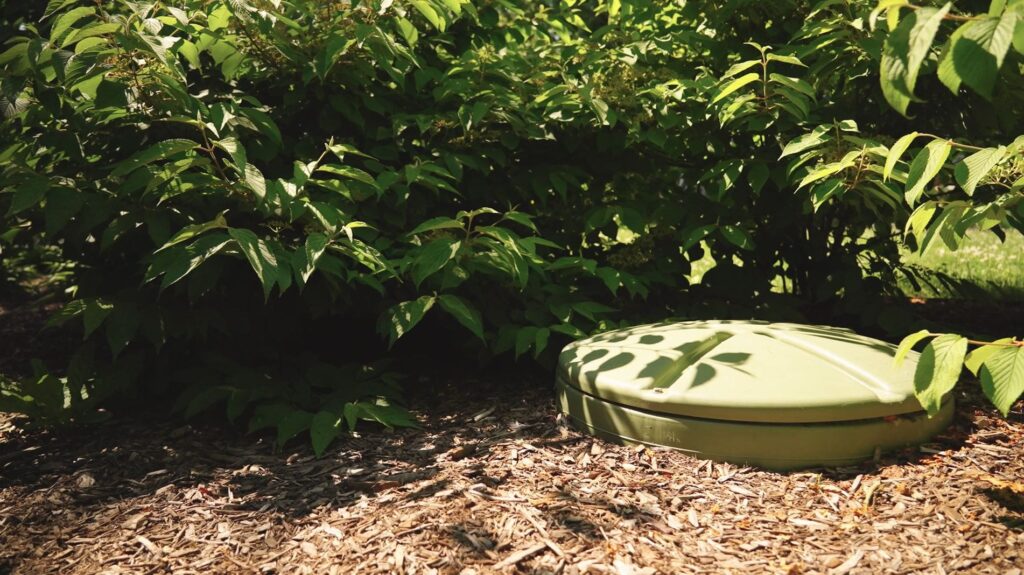
The ATS begins with a grinder pump station inside a tank about the size of a refrigerator that is buried in the ground, its lid easily camouflaged with minor landscaping. The primary component is a 1-hp, semi-positive displacement pump.
The pump blends waste into a fine slurry before its robust torque propels it through small-diameter, inflow-and-infiltration-free pressurized pipe buried just below the frost line (reaching distances of more than two miles or even straight up 185 ft) to an existing gravity sewer as well as a force main or treatment plant. The total dynamic head provides a nearly identical flow rate regardless of the network’s contours and fluctuating elevations.
Budget Friendly Sewer Connections
Patchogue’s site design challenges were formidable starting with a density of 6,000 inhabitants and 4,900 housing units per square mile (the village encompasses 2.2 square miles of land, 0.3 of water). Sand, gravel, silt and clay overlie a sloping bedrock. Groundwater is approximately 2 ft below grade and all parcels sit within the zero to two-year groundwater travel time to the Great South Bay. Street flooding is frequent. Some areas lay mere inches above sea level; others, 10 ft at their highest.
“One of the biggest problems with any sewer project is the infrastructure,” says Mayor Paul V. Pontieri, Jr. “That’s where the cost is. How do you get from the (wastewater treatment) plant over here to the home over here to the business over there?”
The All-Terrain Sewers’ performance and innovation correlates well with the challenge of navigating major infrastructure projects within heavily populated environments while diminishing disruptions to commuters and homeowners. Enhanced by horizontal direction drilling (HDD), pipe installation in shallow and narrow trenches maneuvers under and around existing utility assets and human-made and environmental obstacles making installation minimally intrusive at half the time and cost of gravity sewer excavation.
“The ATS provides expansion capabilities in ways that gravity sewers don’t,” says Timothy Nordberg, village engineer for Patchogue. “It’s almost like a cable network where you put in a pipe instead of a wire and you pass it in front of as many places as you can.”
The networked “web” design of the ATS brings sewers to home and business owners “as needed,” adds Nordberg, enabling on-demand sewer connections with minimal disruption. “We can point a pipe in any direction and kind of just say, ‘we’re here for you when you’re ready’.”
“One of the main reasons we love All-Terrain Sewers is because it gets us into connecting people faster and gets us to connecting more homes for less dollars,” says Christopher A. Weiss, P.E., Senior Vice President, Director of Wastewater Engineering for H2M architects + engineers. “It’s a lot less damaging to the public streets.”
“Long Island proposes unique challenges,” says Kevin Callahan, founder and president of Site Specific Design. “The amount of people that need to move around this island, the conduits of roads. You cannot just shut down a road for a month and dig a deep gravity sewer line. We have to put the system in with the least impact to the community, and we think we did that.”
The first installation of about 25 ATS stations took place in 2001 around Main Street in the business district, growing to 89 pumps by 2005. A 2015 FEMA study estimated that Patchogue’s “system comprises approximately 12,000 lf of gravity sewer, 13 miles of low-pressure sewer and three pump stations.”
Watch this video for an overview of Patchogue’s wastewater management journey – Part 1:
Patchogue’s Economic Resurgence
Patchogue has 410 ATS units in operation. A current project is installing 238 more. The latter’s $22 million budget includes force main installation, all of the grinder pumps, electrical service improvements and existing cesspool or septic system abandonment and restoration (sometimes burying the grinder station in the same hole). The average cost is $30,000 per home.
“The intention of the village is to use the ATS for all eventual cesspool abandonment initiatives, every parcel in the village, including commercial entities,” says Chris Nedwick, E/One’s national sales development manager who has been involved in the Patchogue project for two decades. “We estimate the total number will be in the 1,400-plus range once the entire scope of the cesspool abandonment initiative is complete,” adds Nedwick who remembers, as a youth, riding his bicycle through a Patchogue “bursting at the seams with fishing and clam boats.”
When Patchogue upgraded its gravity sewers (mostly located along Main Street) in 2018, an expansion was ruled out given the price of additional central pump stations to reach the AWTP and the labor-intensive job of dewatering extensive areas. Many ATS installations empty into the existing gravity network sending wastewater to the AWTP which plans to expand capacity from 800,000 gallons to 1.2 million.
“Our current average daily flow is about 450,000 gallons a day,” says Nordberg. “That’s about 50,000 gallons up from what it was about a year ago before we did our current sewer project.
We’re expecting with a few more projects to see 600,000 in the next year,” Nordberg adds.
The project has generated an economic development multiplier effect with new businesses and housing projects piggybacking each other — and spurring job creation.
“When I first took office, we had a big parking problem on Main Street. Nobody was parking on Main Street because there was no place to go,” jokes Pontieri.
“Then housing began. Eighty townhouses, 50-percent affordable. Art Space, which is housing for artists, 100-percent affordable. But they don’t happen without sewers. As they began to build, restaurants began to come in (about three dozen along Main Street today) and look and realize that with sewers, all they had was a hookup fee,” says Pontieri.
Indeed, Patchogue’s revival has spawned a running joke, Nedwick says. “Bellport built a golf course and Patchogue built a wastewater treatment plant. The context being that Bellport remains relatively static while Patchogue has grown by leaps and bounds.”
Part 2:
The Funding Conundrum
Financing to launch Patchogue and other Suffolk County projects began primarily with awards from $168 million in post-Superstorm Sandy resiliency funding from the Federal Emergency Management Agency (FEMA) Hazard Mitigation Grant Program and continually bolstered by grants from the county, state and federal levels–often employing considerable bartering, bargaining and badgering.
“Your challenges always come down to funding,” says Pontieri, who doesn’t hesitate to pick up a phone and encourage New York’s governor or a U.S. senator. “It’s how do you get the funds to do what you want to do and make it work?”
Pontieri, a self-styled “conservative Democrat” who has held the job for 20 years, also served as a village trustee for two decades prior, recording his first vote on a $1.1 million wastewater treatment plant improvement. Later, after an infrastructure grant was promised, “lo and behold, it was supposed to come and it didn’t. So, Newsday (the Long Island newspaper of note) had a picture of me (gesturing) with: ‘Where’s my money?'” Now, it’s more likely that the ever-persistent mayor is photographed displaying a multi-million dollar check with “Sewer Infrastructure” in the memo line.
Government, Dean says, is “the biggest challenge. It moves dreadfully slow, which is a necessary evil so that mistakes aren’t made. As time goes on, costs go up and the scope of the project can decrease from what we envisioned it to be originally,” Dean adds. “That’s obviously the case here (the current phase converting 238 sites). This is a much smaller project than we had originally hoped, but no less impactful for the areas that it’s going into.”
Pontieri made the same point in 2022 at a meeting discussing sewer expansion: “I’m frustrated because five years ago, we would have been doing five or six homes for the same amount of money,” he told constituents. “We do it with what we have–and I’ll keep begging for more money.”
Trimming Operations & Maintenance Costs
Homeowners volunteering for the program incur an annual fee of $650 for all single-family residences. A grinder pump station with a 75-gallon tank is installed through an easement agreement with the property owner and the Village of Patchogue which owns and oversees maintenance and repairs of individual pump stations and the collection system.
Operations and maintenance budgets have been reduced. The ATS’ average mean time between service calls is 10-12 years with no preventive maintenance. Its 25-plus year life cycle is the best in the industry, and one-third to one-half the cost of gravity.
“Life cycle cost is always a part of things. You never look at a capital cost alone. What does it take to do the rest?” says Nordberg.
“The pumps themselves are very simple, our guys are experienced with them,” says Nordberg. “We know that there’s the plug and play of one station to another even with our older and our newer equipment.”
The Final Goal: Environmental Quality of Life for the People & the Bay
The success of Patchogue’s septic-to-sewer transition has resonated. The county “should encourage towns and villages to develop their own sewering plan such as the Village of Patchogue sewering plans,” the Suffolk Comprehensive Water Resources Management Plan said 10 years ago. “The advantage of installing (pressure sewers) is the cost. They reduce the amount of major remote pump stations required, reduce the need for costly deep excavations to install gravity sewers and lower dewatering costs.”
An estimated 3,500 ATS units (including Patchogue) currently operate in Suffolk County and the number will grow to 5,500 by the end of 2025. “With the project pipeline that is in place we expect to have roughly 10,000 connections within the next five-to-seven years at a maximum,” says Nedwick.
One project in the planning phase will extend sanitary sewer service to approximately 648 parcels in the Patchogue River Watershed outside the existing boundary of the Patchogue Sewer District enabling out-of-district customers to connect into Patchogue’s system for treatment at its AWTP.
The summer ritual of beach closures sometimes sees sand tiger sharks taking the bite out of swimmers as well as Long Island’s tourist-dependent South Shore economies. While the specter of “Jaws” lingers (the blockbuster book and movie were inspired by an angler hooking a great white shark weighing 4,550 pounds off nearby Montauk in 1964) it’s more likely that sewage, not blood in the water, steers tourists away. Only weeks into the 2024 season, Long Islanders were advised against swimming at 65 beaches due to flooding from heavy rainfall possibly carrying an excess of Enterococci and E. coli into the bay.
For Patchogue, healing the Great South Bay remains the project’s essential goal and begins on the waterfront. A restoration of the living shoreline with aquatic and semi-aquatic vegetation is replacing a bulkhead to create a soft barrier buffer zone to attenuate storm surge to a greater degree than a hard barrier. The shoreline’s eel grass habitat numbered 200,000 acres in 1930 but only 21,000 acres remain today, much of the loss attributable to wastewater pollution.
“Between the building of the living shoreline, between the sewering of the apartment complexes that we have on the water, beginning to sewer south Patchogue, hopefully we’ll see a change in our water quality over time,” says Pontieri.
Coupled with quality of life.
“As a homeowner, everything has been positive,” says Devlin. “I would say that the All-Terrain Sewer is the way to go.”

Joseph Harmes is a freelance feature writer who has covered the water/wastewater sector, including the evolution and acceptance curve of low-pressure sewer systems, for more than two decades. He has profiled the Western Hemisphere’s largest low-pressure sewer system, among many other innovative projects in this area.








$22 million divided by 238 homes DOES NOT average to $30,000/home. It’s over $92,000/home.